• Facebook
  • Pinterest
  • Instagram
  • YouTube
  • LinkedIn
  • Skip to secondary menu
  • Skip to main content
  • Skip to primary sidebar
  • Skip to footer

Tina's Dynamic Homeschool Plus

Activity, Change, Progress

  • HOME
  • How to
    • Preschool
    • Kindergarten
    • Elementary
    • Middle School
    • High School
      • Science 
  • Planner
  • Lapbooks
    • Trioramas
    • History Games
    • LEGO
  • Shop
  • GET STARTED NOW!
    • Learning Styles
  • 7 Step Planner
    • DIY Best Student Planner
    • Free & Easy DIY Home Management Binder
  • Unit Studies
    • Creation to Ancients
    • Middle Ages to Reform
    • Exploring to Revolution
    • World Wars to Today
    • Science
    • Free Art Curriculum Grades 1 – 8
  • Curriculum
    • More Unit Studies
    • Geography
    • Writing PreK to 12th
    • Geronimo Stilton
  • BootCamp
    • Resources
      • Dynamic Subscriber Freebies
      • Exclusive Subscribers Library
      • Ultimate Unit Study Planner

handsonhomeschooling

7 Easy Hands on Homeschooling Ideas When You’re Not the Bomb Mom

November 11, 2013 | 8 Comments
This post may contain affiliate links. For more information, please see my full disclosure policy.

I was a Nazi homeschooling momma prior to adding hands-on activities to our homeschool day. I will say it: I didn’t like hands-on activities. All I could think of was how time consuming they would be. And what could you possibly learn from doing them that you can’t just pick up and read in a book and understand faster or watch a video.

Hands On Learning For Hands Off Mom

My hallucination dream at the time the kids were small was to have a clean house, that is ALL at one time. You know what I mean. One day I had a clean commode, oh wow. Never mind the kitchen was a mess on the same day, but I was sure proud of that commode. Okay, you get the idea why a great big huge mess hand on ideas didn’t appeal to me.  I was too busy being clean organized. My mantra then: Get up, get started on your school work and I don’t want to hear about being behind.

My kids were afraid of me. I was afraid of myself.  Feeding my crazed notion was the fact that Mr. Senior 2013, like me, was a visual learner so he was fine with “reading” picture books as our great hands-on activity” for the day. There were many times he wanted to do more hands-on, but I failed to see the signals. Okay, no, I didn’t want to see the tell-tale signs because it meant straying off my well-laid out lesson plans and the Nazi momma in me couldn’t do that.

I added in Mr. Awesome to our school and right away, I had huge problems. Besides being overwhelmed because I was teaching more than one child now, he learned best — yep—by hands on.  Horrible mom that I was, I first blamed his “resistance” on him. He can’t sit still, he doesn’t want to learn, he has a bad attitude (oh uhmm let me see he is only 4 years old) and he is behind were all things that I uttered.

I came to the point where I even considered putting them both in public school. Yes, I went there. I was not the bomb mom.

At that lowest point in my homeschooling, I had to decide if I wanted to succeed and to start taking responsibility for it instead of doing what was comfortable for me. I realized that there was going to be no quick fix, but I could start small. Yes, I set out to be a risk taker.

Here are 3 simple tips to help you be a risk taker by bringing in more hands-on learning to your day.

  • The ideas do not have to be complicated. The emphasis is on “doing” and being together or fostering sibling bonds.  Children are content with a lot less than we realize.
  • Try to keep a supply of materials that you keep separate and already organized so that when you decide to do an activity, especially for science then you have a small stash. I use clear shoe boxes for my supplies. For example, I know that food coloring, baking soda and funnels are not going to be in my box because that is in the kitchen. I collect as I go and I do put pieces of sandpaper, magnets, corks, string, beads, beakers, droppers, magnifying glasses, tape, goggles, and baby food jars in there to name a few. It cuts down on the stress of rounding it up and allows us to be spontaneous if we want to.
  • Try to do one hands-on activity a week with all of your kids, NOT per child. When they get older, then they can start helping by rounding up the supplies like my sons did.

Controlled Creativity

Look at this easy list of things to do to bring in hands-on learning to your school. You can use these with a mix and match of ages. I listed hands-on activities that keeps the mess to less at your home when you don’t have the time and energy to keep your house clean.

Hands On Homeschooling Using Puzzles

(putting together a puzzle about the Amazon)

Puzzles girl! Yep, keep it easy. Old or young, not one of my sons complained when they put together a puzzle. Look here at GeoPuzzles too. When purchasing them just think about learning and keep age appropriate puzzles in your home when you need a break for hands-on. Love the mess on this one. (ha ha)

American Civil War Lapbook Notebook | Tina's Dynamic Homeschool Plus
American Civil War Lapbook Notebook 2| Tina's Dynamic Homeschool Plus

Do a lapbook/notebook TOGETHER as ONE family project. I know I have said it before, but lapbooks are an easy fun way to bring in hands on EVEN for older kids.  You know we do ours for enrichment and to break up our routine so we go slower on them.

Several times throughout  the year, we have created one family project.  The first time we studied the  American Civil War unit was an example of this. We did a combination of lapbooking and notebooking. Each of the boys contributed to it.

So instead of having 3 projects going on and being insane because I tripled the amount of work I had to help them finish, I managed just one and this kept it where we could enjoy it.

Eating An Afican Meal when Studying about Africa | Tina's Dynamic Homeschool Plus
Eating An Afican Meal when Studying about Africa 2| Tina's Dynamic Homeschool Plus

Cook a meal together. One year when studying about Africa, we cooked a meal together AND a side benefit to this was supper was already done.

Sometimes the practical side of me wants to take over and I let it.  I think of the benefits of something hands-on to the family if we prepare food.

Think of home made bread, home made pizza when studying about Italy and baking pastries when studying about France.

Look at here Switzerland Homeschool Geography Unit Study (and Lapbook) where my son made bread.

Ancient Egypt Snake Game | Tina's Dynamic Homeschool Plus
Egyptian Game

Play Educational Games together. This year when I couldn’t really find a game they liked or didn’t have one on studying Ancient Egypt, I created an Ancient Egyptian Game. Grab it if you want it too.

Again, I can create in my own time and use the game at the time that I need it or when they need a break for something hands on.

Rainforest Experiment Tinas Dynamic Homeschool Plus (2)

Instead of growing plants, use them to experiment with. Growing up my mother loved to work in the yard almost to a fault. I think it is therapeutic in a way for her. She constantly had us out there digging in dirt when I would have preferred to do something else.

Call me insane, but now I have no desire to grow a plant much less dig in dirt. My siblings all love it. I am the only one that cringes with agony when I think of digging in the dirt. So I use plants already grown, thank you, to do my science activities. Oh I planted a garden one year too and it was pure agony for me. But, I did it when the kids were little so they could learn about plants.

About the picture above, one year we were investigating if a bromeliad (pineapple) could actually hold water and then the boys did play in the dirt to see if they could grow another pineapple.  Another year too, I purchased a (one) tomato plant in a container when the boys were little. When it sprouted and we had tomatoes, they were enamored. I learned that I didn’t have to grow a garden for them to understand plants. A simple bean in a jar and a plant purchased works too.

Native American BeadWork Tinas Dynamic Homeschool Plus
Coffee Filter Book

Leather & Beadwork/Coffee Filter Book. Neither one of these projects are messy either. My sister is almost an expert at leather crafts so we did these pouches for our Native American unit.

But, you can buy leather craft kits already and have the kids put them together. Hobby Lobby has craft kits already put together. I love that place! So many hands on history things to choose from too.

Another easy thing is a coffee filter book. Yep those are coffee filters and we used some pastel chalk (get in some art) to create pictures on each page and then used shoe string with bead work to bind it. That’s it! Easy peasy but they loved it.

Drawing a Cell | Tina's Dynamic Homeschool Plus

Let them “draw” those worksheets. When studying animal and plant cells, I think we probably could have yawned ourselves to sleep if we read about one more cell. Because I wanted my sons to take something away from our study, I allowed them to draw about the topic we were covering. Look ahead in your nice neat well laid out plans and see if there is something better understood by a simple, but fun drawing.

Sometimes I hear homeschoolers say that their kid learns better by just reading.  That has never been my experience. What I have seen though is apprehension or fear of hands-on activities from the parent.

They fear

  • the unknown;
  • the mess;
  • not knowing how to grade hands-on projects or not knowing how to measure progress and
  • it being a flop.

True, all those things may happen and they did to me. I had a rude awakening when some things I planned did not work. However, out of that failure came self-determination to try other things because I saw a tiny spark of the passion for learning in my boys.

There is something about doing hands-on that strengthens the skills of a child and stirs him to be intellectual.

Remember, hands-on activities can have humble beginnings and stay that way until you feel like homeschooling on the wild side. They do not have to be complicated or messy.  I still don’t feel like the bomb mom, but it won’t be because I wasn’t willing to take the risk.

Do you have any activities that you do that are simple, but pack a punch?

Look at these other must-reads:

  • 365 Days Hands-On Homeschool Activities – One for EVERY Day of the Year!
  • How to Grade Hands-on Homeschool Activities and Projects (Free Rubric for Grading)
  • 21 Hands-On Math Activities for Elementary and Middle School
  • Amazing Hands-on History Activities for 14 Ancient Empires (free notebook cover too)

Hugs and love ya,
8 CommentsFiled Under: Be an Exceptional Homeschool Teacher, Hands-On Activities, How To - - -, Teach/Which Subjects to Teach/Cover EVERYTHING Tagged With: hands-on, hands-on activities, handson, handsonhomeschooling

8 Ways to Teach Homeschool History Other Than Chronologically

November 2, 2013 | Leave a Comment
This post may contain affiliate links. For more information, please see my full disclosure policy.

My homeschool roots are in classical education because so many things just chimed true and made complete sense to me like covering history in chronological order when I first started homeschooling. 

Too, my own education in high school mostly focused on American history with no real start in early civilizations or Bible. So when I answered part of Laura’s question on Should Homeschool History Be Covered in Chronological Order, I just had to expand on it. 

I know my family has reaped many benefits for following an organized cycle, whether a curriculum provider does that in 3 or 4 years. 

On the other hand, after that history has to have life or you can lose interest in repeating the same story line.

History is an adventure to say the least because there are so many action packed stories and other side show events or people’s lives that are running parallel to each other that eventually you want to stray off that organized cycle to explore some of the sideshows. 

Because children take in a lot more than we give them credit for at times, I don’t feel it confuses them but infuses them for a love of history when we take time to cover history in other ways.

Humdrum History

Before I list other ways to teach history, look below to understand how to maximize these other ways in your journey. 

  • They work for families who have just taken their kids out of public or private school and are feeling overwhelmed and burned out.
  • They work for families too who have been homeschooling for a while and have hit the humdrum of history. Sometimes you just need a new bounce or spring to your history studies.
  • They work for families that savor history and want to cover it in more depth and for gifted learners who need more substance.
  • Some of the ways work for families who have special needs children who learn through different senses;
  • And depending on the resource, they work for families who have very young children and may not really get the benefit of understanding chronological order or care how the Egyptians kept time before clocks were invented.

History Confusion or Infusion?

Look at the approaches below, all of which I have done at some time or another though  new curriculum has come along.

1. Teach History Through The Lives of Characters. Though this may seem like a literature approach because you are using great literature, it is not. 

A literature approach uses many great books and focuses on many topics of a time period. Teaching history through the life of a person that lived in that time period focuses on events that affect your main character. It is more in line with taking a biography approach to history.

This is how we cover history presently. My very favorite set of books for older kids that we wallow in as much as we can are the books by Genevieve Foster by Beautiful Feet.

These are keepers in my homeschool and ones we never tire of reading. When you learn that Daniel Boone was a little boy growing up at the same time as George Washington, then you appreciate the impact both made on American history.

For younger kids, it is very easy to find books or biographies on famous people like George Washington and for girls like Pocahontas. Another keeper for younger grades is the D’Aulaire collection by Beautiful Feet too.

The American Girl dolls are also a fun way to learn. I think about Native Americans with the Kaya doll. Look here at a page for crafting with dolls.

Make history meaningful by reading the lives of real people with lively literature.  Too, this way is one I feel is better to teach real young kids because they remember people easier than understanding what time period they lived in. There is not a  lack of literature on most famous persons of history and enough to choose from for kindergarten to high school age.  

2. Teach History Through Art. In classical education, art and science are tied into the time period you are studying. However, art does not have to be studied that way.

When history can be learned along with something else that your child loves, it makes it more meaningful. One curriculum that does this is Visual Manna.

Another example is Mapping the World With Art. Geography and history are inextricably linked as it should be and you learn while you watercolor or make maps.

(Source Joy Hakim)

3. Teach History Through Science. For science lovers who need to learn a bit of history through a science brain, Joy Hakim has a series called The Story of Science that we are going to try next. I have seen rave reviews and talked to homeschoolers who used it.  This is a secular source. Sometimes for me that is a good thing so I can add my own Bible content, but many times too it means they tout a no need to believe in God or an evolutionary belief which is contrary to what I want my children to learn. But as homeschoolers I don’t think any of us are not use to tweaking curriculum for our beliefs and worldview. So I will address our belief in creation and dependency on the Creator with my children. From what I have seen the story is so engaging that it is worth the time to tweak those parts. This is another way for us to sneak in some more science with history that we love. Since we haven’t read these yet, the jury is still out on this.


4. Teach History Through Drawing. Children have a natural disposition toward drawing and doodling. So encourage that. Some grow up to draw beautifully.  Mr. Senior 2013 was like this and I used Draw Write Now for him when he was younger.


(Source:Rainbow Resource)

Then also came along Draw and Write Through History which we have used too and love.


The History in Scribe is another fun way to learn about historical events and writing and drawing about them too. This can be used for a child that you expect a little more writing from. There are a lot of free notebooking pages, mine included, where ample space is left for visual diagrams. As you can see, you don’t even have to have a curriculum, just an imagination. For example, a child can draw the flora and fauna that Lewis and Clark saw along their expedition. Then a love for history beyond boring dates that makes me yawn too is revived. They also have a beautiful nature journal to keep as well.

Too, if you have a child delayed in motor skills or a reluctant writer, then drawing is a fun way to engage them, build motor skills AND teach history.


Let go of ALL that thinking that history has to be taught a certain way when you need to and trust your mommy gut on what is best for your child. They will not forget it as they grow older or what you taught them.

5. Teach History By Topic. Though this may sound like a unit study it really is not because the emphasis isn’t on covering all subjects like science, math, and art, etc.,  but it is more about understanding the people and culture from the earliest civilization to present day. Our geography quest we did on Turkey was an example of this.


Turkey%20Report%203%20August%202012 Mini Unit Study:Turkey + {10 Country Report Notebooking Pages}


Though we covered some other topics, the focus was still on the main topic which was to explore the changes ancient to modern on Istanbul, Turkey. We covered it in a few short weeks from the time it was Constantinople until present day. No  restraint on time periods, no control, no cycle 1 or 2, ju


st unequaled and sheer delight in reading and learning what my sons were fascinated with at the time.

famous figures of medieval times cathy diez-luckie
famous figures of the civil war by cathy diez-luckie
american revolution activity book cathy diez luckie
ancient history activity books cathy diez luckie

6.  Teach History Through No Ordinary Paper Dolls. Figures in Motion is geared toward younger children and could obviously be used to enrich your history too. But using something hands on and that is historically accurate, it will help your child to understand the characters of history and build a love of it too.  Give these to your younger children to hold, play with and imagine the time period as the older children tell the story of history.


Copy of Co-op with Chelly 020


(Viking ice cream boat made with vanilla ice cream in a rectangle box and icing in a can with skewers for the sail.)

7. Teach and Learn History With Others. And no, I don’t mean a co-op unless you have the energy to do one.  Keep it simple always and plan with just one other family that your children enjoy being around. That is kind of important. You still want to be friends afterwards so it helps if not only you and another homeschool mom are friends, but the  children are too.

Buddy up with just one other family keeps history something to look forward to each week or every other week. This allows you an off week to cover something you want to about the subject.

One year we studied history with another family and decided what topics to cover each time. No rhyme, no reason to the order of it, just whatever delighted our children to learn together. Too, we met every other week and it was just perfect for us.


Co-op with Chelly 024


We made ice cream Viking ships (of course had to eat it too) and exploded volcanoes when learning about Crete.Co-op with Chelly 010


8. Teach History By Watching Movies. Pop some popcorn and enjoy. Episodes of Liberty’s Kids can be found free on YouTube and there is a free series by John Green on YouTube too for American History.   Movies like Alexander the Great, The Nightmare in Jamestown about the first colony and Lewis and Clark Journey West to name a few can be viewed on Netflix. Be sure to watch with your kids because some of the documentaries give the vivid facts of history that are not so necessary for younger children.


There is also Drive Through History which is on DVDS. Sit back and be entertained by Dave Stotts as you visit places both ancient and modern.

There are so many more ways to teach history other than chronologically.

I know I have said it before too but I am still totally delighted with Brimwood Press because it covers history chronologically in 14 lessons or big huge chunks and not in cycles. Up until this time, again, we had no choices if we wanted to cover it chronologically and move faster. Now, I can use Brimwood Press at anytime or if we lose our way chronologically and still include one of these other ways. I have a choice always too of covering it chronologically in depth by using one of the other providers like I mentioned in my earlier post: Should Homeschool History Be Covered in Chronological Order?


Choices, lots of choices! Give me choices anytime. What about you? Have you found one that fits your needs right now or that you might want to scoot into later?

Hugs and you know I love ya,

8 Ways To Teach Homeschool History Other Than Chronologically @ Tinas Dynamic Homeschool Plus


Leave a CommentFiled Under: How To - - -, Teach Homeschool History Tagged With: american history, early American history, hands on history, hands-on, hands-on activities, handsonhomeschooling, history resources, historyspine, homeschoolcurriculum, homeschoolhistory, middle ages history, secularhistory

Free Fall Unit Study Ideas– For Older Kids Too

September 22, 2013 | 7 Comments
This post may contain affiliate links. For more information, please see my full disclosure policy.

I have free fall unit study ideas for older kids today. Also, I have this page Fall Unit Study {Pumpkins, Leaves, Corn, & More} for more fall ideas.

If I close my eyes and wish real hard, cool air may blow into my back yard here in Texas.

Though today is officially the start of fall, the truth of it is that I am sitting here typing this in my shorts and sandals.

However, I’ve rounded up some free fall unit study ideas and some of older kids too.

Whenever cool weather gets here, we always take time to do something special. It could be simple poetry reading or a craft or two.

Last year, heaven forbid, we don’t cover an apple unit before we complete homeschooling, we finally did one.

Free Fall Unit Study Ideas

This year, since we are focused on South America some poetry and delish sounding fall recipes are looking good.

So I decided to round up some free resources and construct a unit study for you.

Too, because there seems to be a gazillion things for preschoolers, (you know I love them) but not many free resources to include the older kids, I have included some ideas for them too.

Even if you aren’t a unit study lover, I know everybody likes to get off the beaten path and this gives some variety and pizzazz to the day when you need it and well, it’s FREE. Have to love that.

Free Fall Unit Study Planning Ideas | Tina's Dynamic Homeschool Plus

Free Fall Homeschool Unit Study Ideas

I am using one of my planning pages from my Unit Study Planner to show you how ideas can be taken from an idea to a study topic.

You can see above at how I fleshed out my thoughts and I still did not have enough boxes to cover a few facts under history too.

More Fall Ideas for Teens

  • How to Make Pumpkin Spice Body Scrub & 7 Fall DIY Crafts For Teens

The life of Johnny Appleseed could make for a mini geography report on the states he traveled through without making it babyish.

First, there are many subtopics that can fit under fall and some of them are:

  • leaves,
  • trees,
  • pumpkins,
  • autumn-flowering plants,
  • migration, affect of weather on animals,
  • apples,
  • early time keeping,
  • sundials,
  • fall fruits,
  • even wine making or picking grapes,
  • getting sap from a sugar maple tree; and
  • making syrup.

Sometimes just a fact or two about the subtopics can spur the creative juices in both you and your children. Everybody will want to study something different each year to keep it lively.

Next, look at a few of these quick facts or ideas for each subtopic.

Awesome Autumn Vocabulary

Vocabulary ideas for learning about studying about fall for both younger and older children.

  • equinox
  • conifer/deciduous
  • seasonal growth
  • camouflage
  • sugar maple tree
  • Fall or Autumn?
  • supply/demand regarding farming commodities like corn
  • enzymes
 

Autumn Animal Study/Quick Facts

Some oral narration or a mini report focused on one of these animals would work for your animal lover.

Arctic Fox –  It’s fur is brown in the summer to match its surroundings, but in the fall, it sheds it fur and grows a new white fur for camouflage in the upcoming months.

  • Look at my Winter Season Unit Study to learn about the Arctic Fox.

Frogs – In the spring, they are part of the pond food web. In fall, they move onto land and become part of the meadow food web.

  • Look at my Frogs and Toads Unit Study to learn more about frogs.

Dormouse – It feeds eagerly in fall to store up body fat for the winter

The Basement Workshop Store

Autumn Tree Study

Coniferous Forests – Pines and firs make up coniferous forests. These trees are evergreen providing shelter for animals all year long.

Deciduous trees – Their leaves fall off, but their berries, fruit and nuts provide food for the animals in the coming winter.

Maple Sugar – How to tap a maple sugar tree for sap.

Fall Flowering Plants

How does a scientist study in the fall? Preserving plants now to study later.

Do a hands on project and some nature art by sketching the plants, then putting them between two white sheets of construction paper and put a heavy weight on it and wait.

Retrieve them in the dead of winter when there are fewer plants to study and observe.

A chrysanthemum is normally a fall flowering plant and the topic could make a plant study.

Look at my Unit Study Historic Trees to put a history slant on studying about trees.

Fungi Great Decomposers

Field mushrooms – During the fall, field mushrooms spring up overnight in damp pastures and meadows.  Great topic for older students.

History in Autumn

The Ford Motor Company introduced the Model T in October, 1908. Check out the free printable and information.

The Panama Canal was turned back over to Panama in the fall. This would make an excellent topic for older students concerning the engineering feat of this project.

Links: Fall Printables & Lesson Ideas

  • Look at Harvest of the Month Educator’s Corner to tie in an health element or study.
Fall Apple GrowingFall Apple Printing
  • This site, Yakima Valley Museum has a 32 page download A is for Apple with the ideas and information pictured above for an easy craft for the younger kiddos and some for older kids.
  • Fun Autumn Internet Hunt for those that just want to enjoy and not write.

One of the links is not working, but the others are on this scavenger hunt around the net about autumn things. The YouTube video is a math rap song by a teacher teaching perimeter. I ‘m impressed. But I am easily impressed because BELIEVE me you don’t want me singing, much less doing a math rap.

  • Fall Poetry
  • Easy matching fall vocabulary printable
Decomposing
  • Free Lesson Plan/Background Information for Older Students to Learn about What happens to all those dying leaves.

The decomposition column looks like a great idea for a fun and easy hands on project too.

  • This next site has some nice printable flashcards for the younger kids. Click on the pictures on that site to download.
  • Here is an adorable recipe card and canning labels.
Our Journey Westward
  • Fun Notebooking Pages .
  • Check out this Lesson Plan with clickable diagrams about trees. Nice and useful.
File:Leaf morphology no title.svg
  • Helpful pdf on the background of solstice and equinox and making a sun model.
  • Another very useful lesson plan is the Exploring the Solar System toolkit.
  • Lesson on understanding leaves and photosynthesis with answers again. Thank you.
Handprint Autumn Tree Craft
(Photo Credit: Free Kids Craft)
  • Nice keepsake autumn hand print idea
  • And oh my goodness! More chocolate. Dare I admit that I am a football fan too? So when autumn comes around, that is what you catch me doing on Sundays. Look at this recipe from Sweet Simple Stuff.
Football Snack Mix
(Photo Credit: Sweet Simple Stuff)

Autumn Music

We love classical music in our home and so we listened to The Four Seasons by Vivaldi on YouTube and that would make a great music focus.

Listen to Autumn at 20:59 or close to that number.

And then finally don’t forget that I have two full page here of free printables.

I have poetry, lapbooks, apples and art.

What do you think? Either you are hungry, ready to be inspired, or exhausted from reading all these ideas.

Winter NaturExplorers 735x1102 (Pinterest)

Do you have some fall activities you are doing or lined up?

Fall Ya'll Ideas for A Fall Unit Study - Ideas for Older Kids too. Click here to grab them!

Look at these other ideas:

  • Fall Homeschool Learning Resources For Middle School
  • Fall Y’all:Pumpkin Pie in a Bag (Easy Homeschool Co-op Idea)
  • 21 Hands On Homeschooling Ideas to Keep the Winter Chill Off {Activities for Tots to Teens},
Free Fall Unit Study Ideas - For Older Kids Too.

Hugs and tuck this away for when you need it, love ya,

7 CommentsFiled Under: Free Homeschool Resources, Hands-On Activities, My Unit Studies {Free Printables & Hands-on Ideas}, Other Unit Studies, Science, Science Based Tagged With: earthscience, hands-on, hands-on activities, handson, handsonhomeschooling, middleschool, science, teens, unit studies

South America Unit Study Resources

September 6, 2013 | 8 Comments
This post may contain affiliate links. For more information, please see my full disclosure policy.

I have many South America Unit Study resources. Grab more ideas on my Lapbook ideas, and on my Best Homeschool Unit Studies pages.

My first step as far as planning is to determine what I have in my home and what I can find online. 

Planning my unit studies is a lot like cooking from scratch.

First, I like to dig out what is in my pantry, then take a look at what others have too in their “pantry”.

South America Unit Study Resources

Too, at the beginning I decide whether we will do a lapbook or if we will just do some minibooks and keep it notebooking style. 

Besides, a lot of our units we do both a lapbook and some notebooking pages.

Also, I decide if our unit study will be just enrichment to what we are doing day to day or if it’s all we focus on for a while.

SOUTH AMERICA UNIT STUDY

My objectives affect how long we stay  on a unit.

Next, here is my short list for my objectives in this unit and a few goals.

  • Comprehensive overview of the physical geography
  • Focus on landforms like Andes, Machu Picchu and some reminders on the Amazon Rain Forest
  • Understanding the influence of the Spanish Colonial Empire and the key influence Simon Bolivar had in Latin America’s struggle for freedom

  • Build appreciation from our prior study of the Amazon that it is a life line for many and essential to our planet
  • Appreciate a unique design has a Designer by introducing the Galapagos
  • Allow time to immerse in the culture of people living in South America and the similarities and differences of each country though they are all considered Latin America.

We will be doing a lapbook and notebooking pages. I guess you could say for the first unit of the year, we are going all out.

South America Unit Study @ Tina's Dynamic Homeschool Plus

Basically, South America has 12 countries and 2 dependent territories so we have more than enough to keep us learning for quite a while.

You'll love these South America Free Resources Unit Study @ Tina's Dynamic Homeschool Plus

After all, we will spend time looking at what we have covered up to this time, so I can build my unit study on that foundation.

My South America Unit Study Resources

South America and Rainforest Free Notebooking Pages @ Tina's Dynamic Homeschool Plus

I have a total of 12 notebooking pages right now on my page on the Amazon Rain Forest which I could use in this study.

I have free Rainforest lapbooks too on my site.

However, because I want to focus on the other parts of South America and because the boys are a bit older, I already see that I will need some more printables. So I will be sharing those with you soon too.

You'll love these South America Free Resources Unit Study @ Tina's Dynamic Homeschool Plus
After I gathered the books I had on South America which happen to be mostly atlases, I know I need a trip to the library.

You'll love these South America Free Resources Unit Study @ Tina's Dynamic Homeschool Plus

However, the library didn’t have as many as I would have wanted in the adult section.

Besides, they had some and that is more than enough to start a good thorough unit study.

SOUTH AMERICA UNITY STUDY ACTIVITIES

In addition, look at the resources and activities I have on my page.

  • Free Machu Picchu Mini Book & Completed South America Lapbook
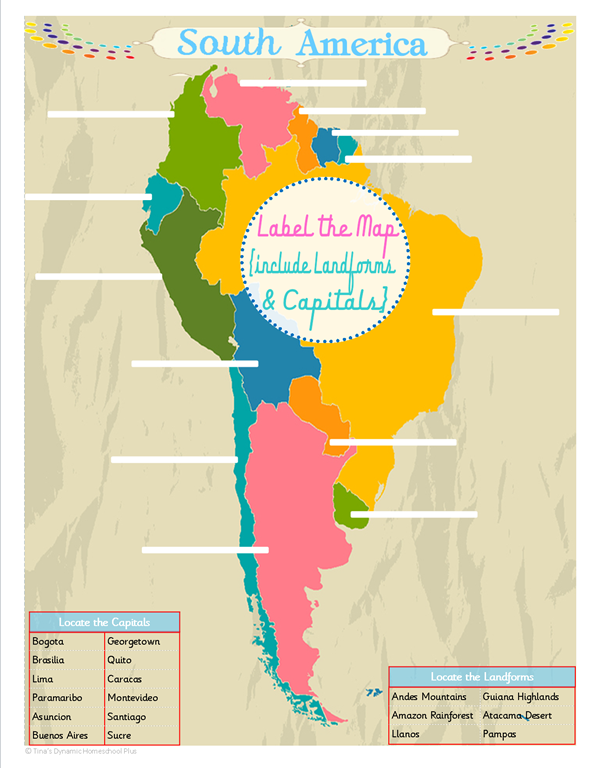
  • South America Unit Study– Colorful Free Printable Map
  • How to Memorize the Countries of South America & Mountain Climate Zones Minibooks
  • South America Unit Study–Vocabulary & Copy work
  • Free Mini Layered Book – South America Galapagos Islands
  • Free 8 Page Fan Book–Animals of the Galapagos Islands
  • Humboldt Who? Hands On to Understand Ocean Currents & Their Effect On The Galapagos Islands
  • How To Make A Blue-Footed Booby Bird Craft
  • Fun Chocolate Unit Study and DIY Chocolate Candy Bar Activity
  • How to Make Paper Mache Mountains to Celebrate Chimborazo Day
  • South America Geography Salt Dough Map + Printable Pennants
  • Negrinho From Brazil–South America Unit Study
  • Appreciating the Culture of South America Through Dance
  • 8 Small Things About Traveling to Cuenca, Ecuador that Make a Big Difference
  • 5 Things I Love About Cuenca Ecuador
  • Everyday Life in Cuenca, Ecuador
  • We Arrived in South America!!!!
  •  Free South America Country Reports for Kids Notebooking Pages
  • Effigies Celebrations and Customs of Cuenca Ecuador
  • How to Make a Felt Mountain Craft | 7 Andes Mountain Facts For Kids
  • Galapagos Islands Animals Fun and Simple Watercolor Flamingo Tutorial
  • Free South America Printable Lapbook and Fun Hands-on Unit Study Ideas

  • Llama Love And Creative Machu Picchu Crafts for Kids
  • Easy And Fun Rainstick South America Craft For Kids
  • Easy Peru Crafts For Kids And Unit Study Outline

South America Unit Study Ideas to Borrow

Additionally, there are so many talented teachers in the homeschool world, we can see what else we find. I have linked some of my favorite resources here.

1. Heather over at Blog She Wrote starts with a Geography Quest on Brazil. It starts with a treasure hunt and ends in Brazil. Then they did a map of the watershed of the Amazon River.
Geography Quest on Brazil Answers and a video.

2. Jolanthe over at Homeschool Creations has some great stuff too. She has some printables for a country study on Argentina, Chili, Peru and Venezuela.

3.  Then of course I always love Amy’s stuff over at Homeschool Share.

  • Brazil Lapbook
  • Colombia Lapbook
  • Ecuador Lapbook

4. Heidi over at Homeschool Room has a nice collection of geography resources on studying Brazil. Geography Resources for Studying Brazil

South America Unit Study Resources. I have many South America Unit Study resources. Grab more ideas on my lapbook ideas, and on my best homeschool unit studies pages. My first step as far as planning is to determine what I have in my home and what I can find online. Planning my unit studies is a lot like cooking from scratch. First, I like to dig out what is in my pantry, then take a look at what others have too in their “pantry”. Too, at the beginning I decide whether we will do a lapbook,
Ocean Currents and The Galapagos1
South America Unit Study Resources. I have many South America Unit Study resources. Grab more ideas on my lapbook ideas, and on my best homeschool unit studies pages. My first step as far as planning is to determine what I have in my home and what I can find online. Planning my unit studies is a lot like cooking from scratch. First, I like to dig out what is in my pantry, then take a look at what others have too in their “pantry”. Too, at the beginning I decide whether we will do a lapbook,
South America Unit Study resources

HOW TO GET THE FREE SOUTH AMERICA LAPBOOK

Finally, look at how to grab the free lapbook. This is a subscriber freebie.

Also, look at these minibooks which come in the free South America lapbook 27 page download.

  • Vocabulary Pocket and Vocabulary Words
  • Animals of the Galapagos fan book which includes the Giant Tortoise, Lava Lizard, Marine Iguana, Green Turtle, Galapagos Penguins, Magnificent Frigate Bird, Blue-Footed Booby, and Blue-Banded Goby.
  • Comparing Mountain Climate Zones
  • Simon Bolivar Copywork
  • Map of South America to label and one labeled
  • Machu Picchu – Lost City of the Inca
  • Negrinho – A dessert from Brazil
  • How to Memorize the Countries of South America and Dependent
  • Map Flags to put on your salt dough map
  • 2 – The Galapagos Island layered book. One prefilled with facts and one blank to add your own information.

 1) Sign up on my list and get this freebie at the same time.
 2) You’ll instantly be directed to download the printable.
3) Last, look for my emails in your inbox as a follower. Glad to have you following me!

8 CommentsFiled Under: Geography Based, My Unit Studies {Free Printables & Hands-on Ideas}, Science Based Tagged With: hands on history, hands-on, hands-on activities, handson, handsonhomeschooling, history, homeschool, homeschoolgeography, south america, unit studies

Review of What Every Child Needs to Know About Western Civilization

August 26, 2013 | Leave a Comment
This post may contain affiliate links. For more information, please see my full disclosure policy.

I loved doing a review of what every child needs to know about Western Civilization.

My obsession with wanting to teach history creatively stems from a quote I read by H.G. Wells.

“Narrow history teaching of our school days was mainly an uninspiring and partially forgotten list of national kings or presidents.“

Avoiding uninspiring lists and meeting the challenge of dodging inside-the-box history curriculum has not always been easy.

So I was happy to review What Every Child Needs to Know About Western Civilization by BrimWood Press.

I will just tell you now that I won’t hide my obvious preference for this curriculum.

It fills a much needed niche in the homeschooling community, but it is so much more than a history curriculum. More on that in a minute.

What Every Child Needs to Know About Western Civilization by BrimWood Press

I glanced through all the fascinating and detailed pictures.

The BrimWood press bundle I received included:

  • 1 Guide: What Every Child Needs to Know about Western Civilization.
  • 1 Calendar Quest which is a historical narrative.
  • 1 Color the Western World.

I am especially giddy about this curriculum.

It is the first one that I have used that covers history in broad strokes.

How broad? Well, in just 12 – 14 lessons you cover 5,000 years of history.

Review of What Every Child Needs to Know About Western Civilization by BrimWood Press

I had to read that twice. I might add there are 2 more lessons, but one is an introduction and one is a review.

Details can be fascinating, but they can get in the way too.

Not all details are necessary to understanding and grasping the full picture. Sometimes it just does not matter. I think kids know that too.

Middle School Homeschool History

I have covered history through unit studies, through a four year cycle and through the eyes of individuals that lived in each time period, I couldn’t wait to get started using it.

This teaches a story of how the calendar came to us which is how What Every Child Needs to Know about Western Civilization teaches. Clever.

As the fictional characters, Lindsie and Evan travel through time in a refrigerator box, Tiny eagerly tuned in,

Strangely enough Father Time always seems to be around to explain about how a seven day week came to us or how the constellations were located in the sky.

It didn’t hurt either that Mr. Awesome joined us for this review and read aloud to us. I highly recommend using your highschooler for a read aloud if you have one.

I am happy that my high school teen joined us for this review .

It allowed me to evaluate how extensive it was for him a high school teen.

Homeschool History

With the additional activities listed in the manual that include research, questions concerning worldview, introduction to the traits of each civilization and the contributions made by each civilization, I certainly think that a novice or highschooler could use the manual to discover them.

Too, if you have highschooler who is burned out on history, then using the manual can breathe life back into your day.

The wide scope that it covers keeps it so not intimidating.

As for the reader or Calendar Quest, it is written to an elementary age child. 

However, there were some characters along Lindsie and Evan’s trek that Mr. Awesome and I had obscurely heard of. Discovering those vague history characters was an unexpected benefit of Mr. Awesome reading to Tiny. 

Mr. Awesome claimed the reader was too young for him and it was, but then again, it is right on grade level like the publisher claims for using with a younger child. Tiny enjoyed the humor in the reader and I found a way for my older child to join us.

What I love about What Every Child Needs to Know about Western Civilization.

Like I mentioned before, it is so much more than a history program. Listing both the history features that I loved and the other things, I don’t want to miss giving you any nifty detail.

  • I find the lesson plan layout very useful. You know my obsession with expecting a lot from a teacher’s manual and how some manuals are nothing more than an answer sheet. This is an excellent and well organized manual or guide with practical tips. You see exactly how to cover each lesson.
  • One more significant point about this manual is that it is BOTH teacher and student guide. You use it with ALL of your children. Thank you BrimWood Press for understanding that we are teaching multiple ages of children and that we try to avoid insanity by not using 3 or 4 different teacher’s manuals.
  • Use this one manual for multiple ages of children. By the way when I find a curriculum like this that I can use with multiple ages of children, I try to divide the price by the number of children using it so I can see what I am actually paying for each child per year. Then divide it again into half because it is both teacher manual and student manual to get a true cost. That is how I arrive at the value of a curriculum that I use with multiple children.

Teacher Manual Features

Review of What Every Child Needs to Know About Western Civilization by BrimWood Press
  • I’m not done yet with the manual because it is so comprehensive and I have to tell you about the layout. The first page of the lesson has a box called Teacher Preview and another one called Objectives. Oh YES – I am in organization bliss! Give me a purpose for the lesson and I have a direction for the day.
  • Here is another sweet bite on this program because you know I said it was so much more than a history program.  It has geography and a snip of language arts too. This especially feeds my desire to teach out of the box because I can include any subject I want to and apply those subjects when I teach about a topic. It’s more meaningful to include details when they are wanted.

Teaching Helps

  • The next part of the lesson is called History in a Nutshell. It includes information on the significant contributions of that time period along with instructions on coloring the stickers for the younger kids that are included in this curriculum. Information on filling out the 14 Hats of History which are the 14 periods you are striving to memorize is included in this section. Several lessons include helpful background information of that time period. You do not have to research extra information if you do not want to because it is included. This part appeals to me so that I can determine if those foundational pegs or key events are covered when teaching that time period. This part is the reason I see this manual being practical too for the first time history teacher or student who finds history boring and wants just the general sweeping ideas.
  • Between the stickers and Color the Western World coloring book there is plenty to choose from for both your younger and older children.

History in Broad Strokes

  • Key events that you add on the back of the cards and details that you fill in on the front of each card as you go along help to solidify the timeline of history. We followed along in each lesson plan as you are encouraged by the curriculum to try to put your hats in chronological order. By using both the front and back of the card, your kids come away with a fresh, unique and overall picture of history. Certainly, a doable goal to memorize all 14 time periods. This is a refreshing change from all the details that you may be teaching when using a four year history cycle curriculum.

I won’t be giving up my copy of What Every Child Needs to Know about Western Civilization any time soon as I plan on using this for years to come.

It is a keeper in my home, and I plan on going over it again both as a standalone history curriculum and to use as a review tool.

My boys still need to see the flow of history and a way to tie it all together.

I tend to be organized overboard when it comes to details because we love history, but I restrained myself from delving into them like the curriculum suggested because it defeats the purpose of what I am trying to do.

Don’t pitch your slow moving curriculum, just use What Every Child Needs to Know about Western Civilization when you want to take it up a notch.

Thank you BrimWood Press as I confess my absolute love and bias for a one of kind history program.

Where to Buy What Every Child Needs to Know about Western Civilization and Product Facts at a Glance.

Product Name: What Every Child Needs to Know About Western Civilization, Calendar Quest and Color the Western World.

Ages: 5th – 8th grade, but I see a practical use for highschoolers who struggle with history.

Type of Product:  Physical product.

What Every Child Needs to Know About Western Civilization is an awesome homeschool history program covering history in broad strokes. You’ll love how quickly you can cover 5000 years of history in a few weeks. Check it out at Tina’s Dynamic Homeschool Plus

You’ll love these other history helps:

  • 35 Simple But Powerful American History Homeschool Resources K to 12
  • 15 EASY History Ideas for Homeschooled Kids Who Don’t Like School
  • How to Create a Creditworthy American History Course (& resources)
  • Amazing Hands-on History Activities for 14 Ancient Empires (free notebook cover too)

Leave a CommentFiled Under: Hands-On Activities, History Resources, Homeschool Curriculum Review Tagged With: brimwoodpress, handsonhomeschooling, history, homeschool, homeschoolhistory, medieval homeschool history, middle ages history, middleschool

  • « Go to Previous Page
  • Page 1
  • Interim pages omitted …
  • Page 222
  • Page 223
  • Page 224
  • Page 225
  • Page 226
  • Go to Next Page »

Primary Sidebar

Footer

Privacy Policy | About Me | Reviews | Contact | Advertise

Categories

Archives

Tina Robertson is a participant in the Amazon Services LLC Associates Program, an affiliate advertising program designed to provide a means for sites to earn advertising fees by advertising and linking to amazon.com. As an Amazon Associate, I earn from qualifying purchases.

Copyright © 2026 · 5 TNT LLC · Log in · Privacy Policy