• Facebook
  • Pinterest
  • Instagram
  • YouTube
  • LinkedIn
  • Skip to secondary menu
  • Skip to main content
  • Skip to primary sidebar
  • Skip to footer

Tina's Dynamic Homeschool Plus

Activity, Change, Progress

  • HOME
  • How to
    • Preschool
    • Kindergarten
    • Elementary
      • Geronimo Stilton Books
    • Middle School
    • High School
      • Science 
  • Planner
  • Lapbooks
    • Trioramas
    • History Games
    • LEGO
  • Shop
  • GET STARTED NOW!
    • Learning Styles
  • 7 Step Planner
    • Free Student Planner
    • Free Home Binder
  • Unit Studies
    • Creation to Ancients
      • Mesopotamia
    • Middle Ages to Reform
    • Exploring to Revolution
    • World Wars to Today
    • Science
  • Curriculum
    • More Unit Studies
    • Geography
    • Writing PreK to 12th
    • Free Art Curriculum
  • BootCamp
    • Resources
      • Ultimate Unit Study Planner

homeschoolanguagearts

Letting Go of the Homeschool Language Arts Stranglehold

January 27, 2015 | 6 Comments
This post may contain affiliate links. For more information, please see my full disclosure policy.

Covering homeschool language arts and no other subjects for the day is not just dull, boring and unbalanced but it can also suck the life out a child’s desire to read and write every day.

Letting go of the homeschool language arts stranglehold is not easy.  Wanting our children to succeed in life and not wanting them to miss something vital in the area of language arts, many parents, including myself, have unintentionally piled on double the subjects in language arts.

Letting Go of the Homeschool Language Arts Stranglehold

Instead of feeding a child’s natural eagerness to learn through language arts, we create resistant learners.

e;”>Understanding the elements of language arts keeps them from over taking hands-on science activities, history projects or art projects that our children can’t wait to do.

Key to covering language arts well, but keeping it balanced with the other activities is being sure we know what the subjects are.

It is hard to know if you are covering the essentials when you use such a broad general term like language arts.

Homeschool Language Arts – Think Communicate

Because I was not a public school teacher in my LBK (life before kids) and because I always need to compartmentalize before I can tackle a job, today, I want to help you clearly identify and categorize which subjects make up language arts at each level.

Language arts is a term used to cover how we communicate, whether it’s spoken communication or written communication.

In each grade level, language art subjects will vary but the subject will cover one of those two areas.  You don’t have to have a public school teacher background to figure it out.

For example, at the beginning level, teaching phonics is about teaching our elementary children how to read.  At the middle school level, teaching our children composition is about teaching them how to communicate their ideas efficiently. At the high school level, language arts can take a different turn and it’s about how to teach our high school students to orally communicate effectively.

As just a mom, I don’t like the term language arts because it is too broad and does not help you to grasp which subjects to teach at which grade levels.
Language arts can be a whole host of subjects but most of them fall into these 5 subcategories.

Reading

Writing

Spelling

Grammar

Oral

Identifying them each year and then filling the need, keeps language arts as a subject that is not only thoroughly enjoyable to learn about, but keeps it balanced.

Look at this list of a whole host of subjects and teaching techniques used interchangeably that make it seem almost impossible to organize.

Phonics, word study, narration, dictation, grammar, literature, English, speech, penmanship, drama, public speaking, poetry recitation, memory work, composition, spelling, reading comprehension, speaking and listening and outlining are just some of the subjects that I have seen through the years.

While some are subjects like composition, which have numerous ways to teach it and various genres and some are techniques like copywork, which teach a whole host of skills, they all generally fall into reading, writing, spelling, grammar or oral categories.

Too, one subject can teach multiple language arts skills.

Elementary Homeschool Language Arts

Look at these samples below of how I categorized subjects or teaching techniques.

This is not an exhaustive list by any means because there are an overwhelming amount of superior teaching techniques as well as excellent language art curriculum that we can seize for the year.

I just sorted through some of them to show you how I organize them both mentally and most of the time in my planner so that I keep a balanced plan.

Middle School and High School Homeschool Language Arts

Too, I haven’t even touched on how language arts skills can be honed by using novels, poetry, science and history topics.

The point of today’s blog post is for you to rein in the numerous techniques and subjects in language arts that constantly bombards us.

It helps to see that many years were are either meeting or exceeding standards for a grade level.

Some years, I have very slim language arts curriculum and more reference type books because language arts is taught through another meaningful subject like history.

For example, if you have a boy that does not like writing, he can see the value of learning it while he can write about ancient weapons. A reference book to guide him on his subject is of more value.  If you have a girl that would rather read about fashion or horses than write, then a reference book about creative writing will inspire her to write her own story.

How Do You Keep Homeschool Language Arts from Choking Out Your Other Subjects?

Did I mention that covering language arts while study science, history or the history of art is the simple trick to balancing language arts while still getting in your much loved subjects for the day?

Covering only language arts for the day and not finishing until 2:00 p.m is a recipe for disaster.

I hope that by simplifying some of the subjects and techniques for you that you will see that you are probably more than just meeting the basics each day.

Most homeschoolers I have helped have way too much curriculum in language arts and do not realize that language arts spans just about any other type of subjects.

Whether you are learning about art, history, science or the Bible, you have to read, decipher sounds, infer, follow directions and explain or tell back what you have learned and somewhere along the way write down instructions, follow directions, label and diagram.

Sorting through my language arts curriculum each year helps me to isolate curriculum to fit within the categories of the big 5 (reading, writing, spelling, grammar and oral).

Too, it helps me to not over plan but to realize that I will cover different parts of language arts through our love of other  subjects.

How do you keep language arts from choking out the other activities you have on tap for the day?

You’ll love these other tips:

  • What Homeschool Subjects to Teach and When to Teach Them
  •  Are You Qualified to Teach Your Homeschooled Children? Part 1.
  • Do You Need to Know What a Scope and Sequence Is When You Homeschool? Tips for the Beginner.
  •  Divide And Conquer The Ever Growing List of Homeschool Subjects

Hugs and love ya,
 

6 CommentsFiled Under: Teach Homeschool Language Arts, Teach/Which Subjects to Teach/Cover EVERYTHING Tagged With: homeschoolanguagearts

Free Marco Polo Unit Study Notebooking Pages

January 12, 2015 | 4 Comments
This post may contain affiliate links. For more information, please see my full disclosure policy.

Today, I have the first set of free Marco Polo Notebooking Pages ready to go with my free Marco Polo lapbook and unit study.

The first notebooking page is a place to write about Marco Polo’s childhood as he grew up in Venice and contemplated visiting far off places that were not discovered.

Free Marco Polo Unit Study Notebooking Pages

The second notebooking page, your child can add a bit of geography about the Persian desert and there is space for your child to either describe the travels of Marco Polo across the Persian desert or to tell about animal or plant life on the desert.

And then lastly, I have a page that can be used to give an overview of the Mongol Empire.

The Mongolian Empire was such a huge empire at that time that it is taken us a while when reading to wrap our minds around the large amount of land that was conquered by Genghis Khan.

Also, look at these fun books about Marco Polo.

Books About Marco Polo For Kids

10 Marco Polo Books & Resources for Kids Who Love Reading and Being Read To

Add some of these fun books about Marco Polo to your home library or use them in your unit studies.

Image for Marco Polo

Marco Polo

The amazing story of a Venetian trader who becomes an aide to the great Kublai Khan comes to life in this retelling for students by Manuel Komroff. Follow along as Marco Polo travels through deserts littered with bones, encounters animals previously unknown to Europeans, and comes to serve in the court of one of the greatest kingdoms ever known.Included is a gorgeous new map tracing his journey, and 29 full page illustrations from an early edition written for adults.The text in this edition is a reprint of the original Messner Biography, a series that was created for students. "Well told and with engaging narratives, they unknowingly flow nicely from story to fact. You will find a plethora of information packed between these pages, not only about the title’s subject, but the subject's time and the world they lived in."

Image for The Adventures of Marco Polo

The Adventures of Marco Polo

Was Marco Polo the world's greatest explorer -- or the world's greatest liar? Newbery Medalist Russell Freedman turns his eagle eye on the enigmatic Marco Polo in his most exciting biography yet.

He claimed to have seen rocks burn, bandits command sandstorms, lions tamed with a look, and sorcerers charm sharks while divers gathered pearls on the ocean floor. Marco Polo shook Europe with descriptions of the world he'd seen on his epic journey to the court of Kublai Khan.

But was Marco Polo the world's most accomplished explorer? Had he really seen the "Roof of the World" in Central Asia, and the "City of Heaven" in far-off China? Or was he a charlatan who saw nothing more than the conjurings of his inventive mind? Join Russell Freedman as he tackles a centuries-old mystery.

Image for The Story of Marco Polo

The Story of Marco Polo

This is volume number 22 in the Signature Books series for young readers. This series, under the general editorship of Enid Lamonte Meadowcroft, provides easy to read, exciting stories based upon the lives of historical figures. A vivid story of the life and adventures of perhaps the most romantic traveler of all time, a man who returned from the East with tales so fantastic that no one believed him until he was vindicated by later travelers.

Image for Animals Marco Polo Saw (Explorer Series)

Animals Marco Polo Saw (Explorer Series)

A continuation of the Explorers series by award-winning author Sandra Markle, Animals Marco Polo Saw brings to life the amazing, exotic animals Marco Polo encountered during his explorations in Asia, how the animals sometimes affected the outcome of the journey, and even helped the explorer survive!

Image for Marco Polo (Junior World Explorers)

Marco Polo (Junior World Explorers)

Examines the political forces and personal ambition that drove Marco Polo in his explorations.

Image for The Travels of Marco Polo

The Travels of Marco Polo

Marco Polo was the most famous traveller of his time. His voyages began in 1271 with a visit to China, after which he served the Kubilai Khan on numerous diplomatic missions. On his return to the West, he was made a prisoner of war and met Rustichello of Pisa, with whom he collaborated on this book. The accounts of his travels provide a fascinating glimpse of the different societies he encountered: their religions, customs, ceremonies and way of life; on the spices and silks of the East; on precious gems, exotic vegetation and wild beasts. He tells the story of the holy shoemaker, the wicked caliph and the three kings, among a great many others, evoking a remote and long-vanished world with colour and immediacy. He found himself traversing the most exotic lands-from the dazzling Mongol empire to Tibet and Burma. This fascinating chronicle still serves as the most vivid depiction of the mysterious East in the Middle Ages.

Image for He Went With Marco Polo

He Went With Marco Polo

Cathay is a long way from his home in Venice, but when 14-year-old gondolier, Tonio Tumba receives the chance of a lifetime, he doesn’t say no. Leaving behind his only possession, a shabby green gondola, Tonio eagerly joins Marco Polo on his adventure.

As Tonio and the Polo family travel the dangerous silk road to modern-day China, they encounter many fascinating people and dangerous perils. When Tonio rides into Cathay on one of the Khan’s elephants, he says to his friend, Pietro: “Elephants are grand… but give me a horse any time – unless I could have a gondola. When we get back to Venice, I’ll take you out in mine.”

There are many wonderful sights, amazing inventions and great riches to discover, though Tonio looks forward to getting back home - but many years will pass before his chance to see the canals of Venice again. When so much has changed, will Tonio find anything worth returning for?

Louise Andrews Kent is a master storyteller, weaving historical accuracy and immersive adventure into one epic voyage of discovery.

This new edition features all the original illustrations and clean, readable text. It is a fantastic living book teaching about history and geography, recommended for ages 10 and up.

Image for Genghis Khan and the Mongol Horde (World Landmark Books)

Genghis Khan and the Mongol Horde (World Landmark Books)

Excellent, historic story well told by Harold Lamb and beautifully illustrated by Elton Fax. Originally published in 1954, this paperback edition was released in 1982.

Image for Marco Polo: Overland to China (In the Footsteps of Explorers)

Marco Polo: Overland to China (In the Footsteps of Explorers)

Relive Italian voyager Marco Polo's adventures in China in1275, including his legendary meeting with Kublai Khan, emperor of the powerful Mongol Empire. This exciting new book separates fact from myth using excerpts from Polo's actual journals and vivid illustrations and photographs to portray Polo himself and his impressions of the unique traditions and customs of the Mongols. A recipe from the period is also included. Topics include - what the Medieval period meant to Europe and exploration - the Silk Road - Marco Polo's service in Kublai Khan's court - life at sea and in the Mongol Empire - Marco Polo's influence on later explorers Teacher's guide available.

Image for Marco Polo: his travels and adventures.

Marco Polo: his travels and adventures.

This edition is presented complete and unabridged, with larger text for easier reading by younger readers, and all the original illustrations and decorations.“I have attempted to transform the somewhat dry and monotonous translation of this narrative into an entertaining story, that may engage the attention and the interest of my young readers; for which it certainly presents ample opportunities. If the task is properly done, no one can fail to follow Marco Polo from his Venetian home, across the entire continent of Asia to the court of Kublai Khan, and in his various adventures and journeys while in the far-off Orient, without eager curiosity and ever-deepening interest. The central figure of the story is heroic, for Marco Polo was in all things manly, brave, persevering, intelligent, and chivalrous; and the scenes and incidents in which he was the leading actor were in the highest degree thrilling and dramatic.”-From the Preface by the Author.

MARCO POLO NOTEBOOKING PAGES

Also you’ll love the hands-on ideas from Home School In the Woods.

Here are a few websites we have been reading that might help you too.

  • The Mongol History
  • Mr. Donn
  • Mr. Donn Mongol for Kids

The printables on the Marco Polo Unit Study are special ones because I love to hold back printables to share only with my loyal email readers.

Go here to grab the free Marco Polo lapbook.

Marco Polo Unit Study Hands-on Activities

  • Make a Persian Mosaic
  • Learn how to make the extend a timeline book
  • Make Terra Cotta Warriors
  • Grab these free Notebooking Pages
  • Create this salt dough map of the Travels of Marco Polo and grab the printable map flags.

How to Get the Free Notebooking Pages

Free Marco Polo Unit Study Notebooking Pages

Now, how to grab the free notebooking pages. It’s a subscriber freebie.

When you sign up to follow me, you get access to this freebie AND you’re now a follower of me by getting emails in in your inbox.

1) Sign up on my email list.
2) Grab the printable.
3) Last, look for my emails in your inbox as a follower. Glad to have you.

Marco Polo Unit Study, Lapbook, and Hands-on Ideas

Check out these other activities on our Marco Polo Unit Study.

 Hugs and love ya,

Free Marco Polo Notebooking Pages for a homeschool unit study.

4 CommentsFiled Under: 1. My FREE Learning Printables {Any Topic}, Geography Based, History Based Tagged With: hands on history, hands-on, hands-on activities, handsonhomeschooling, homeschoolanguagearts, language arts, languagearts, notebooking

What You’ve Got To Know About Teaching Reading Comprehension

October 10, 2014 | 2 Comments
This post may contain affiliate links. For more information, please see my full disclosure policy.

Today, in what you’ve got to know about teaching reading comprehension, I will share surefire ways to rekindle the love of reading. More important these tips will help your child understand what he is reading.

When I took Mr. Senior 2013 out of public school for the short time he was in Kindergarten and started homeschooling him again, I realized that he had changed from adoring his reading time to abhorring it.

Reading Material Matters. 

I am always astounded at how children naturally figure things out and they know when something they are reading matters.  One book I had chosen to focus on my son’s reading comprehension was called Bags The Lamb.

Okay, not very inspiring title and so I soon learned that my first mistake in helping my son to care about what he was reading was to make it matter. 

One stepping stone to having your child lap up reading is to give him a meaningful purpose.

For Mr. Senior 2013 that meant reading a comic book or a non-fiction book about science or history. 

If you are using a reading program that has dry, boring books that do not matter to your child, then use a book they choose so it matters to them. 

What You’ve Got To Know About Teaching Reading Comprehension

This is the first step to encouraging them to make meaning of what they are reading.

A Skillful Teacher Models the Process. 

Then there is one pet peeve of mine that we unknowingly do in a lot of subjects that we teach and that is somehow by osmosis we expect our kids to know what we want.

I too made this mistake in thinking my son knew how to skim the material, ask questions silently and look for answers in reading material.

Switching my approach, I focused on one paragraph in the book that he chose and talked out loud while he was sitting with me.

I would continue to talk out loud asking who is this character or I would say this reminds me of so and so whom we both know.

In talking out loud, I was helping my son to make a connection with what he knew right now and otherwise question what he was reading.

He soon learned that it was okay to have questions and that questions are the beginning to understanding what he was reading.  It is not necessary to

have all the questions answered, which is what Mr. Senior 2013 was doing.

Reading comprehension is about weighing and identifying facts though not always having the answers until the end of the story.

Slow Down Your Reading Pace Mama! 

Another mistake I was making was allowing my kindergartener to read the whole story in one gulp. 

What good did that do him if he didn’t understand the first paragraph?

He had me fooled because he was such a good reader, never mind the fact that he didn’t understand too much of what he read. 

I realized he was hyper focused on rapid reading and correct pronunciation instead of understanding what he was reading.

No wonder he didn’t like reading at the time because it became more about reciting meaningless chants instead of savoring the satisfaction that comes from filling his mind about the fascinating world around him.

From that time on, I assigned my 1:1 reading time with him for just one or two paragraphs each day. 

Implementing my tip on modeling the process, I read the paragraph or two aloud the first time. 

Pausing at commas, and emphasizing important words by the inflection in my voice helped him to see how he should be reading. 

This tip significantly improved his reading comprehension in the first few months.

Besides forming a close bond with him, to this day he has never forgotten the warm fuzzy feeling that comes from understanding what he is reading.

The rest of the day as a Kindergartener he spent with alone reading time, but I could hear him off in the room practicing some of what I had modeled.

By taking this 1:1 crucial time with him, my reader who once loved reading prior to sending him to public school returned to a love of reading.

Visualize and Imagine. 

Too, I had not tapped into my son’s love of visualization. 

Boys especially need to use this strategy. Again, he was a very visual person, but I had not helped him to see that he needed to use that strength to visualize the characters or place.

I had read somewhere that we should teach them like it’s a movie going on in their head. 

It’s true.  I helped him to see that if he could picture what a character wore, how he sounded when he talked and where he lived that those things would add to his understanding of what he was reading. 

It worked. Simply explaining that to my son and helping him to make that connection was all he needed to rapidly improve his reading comprehension.

I learned again that we need to tell and give our kids those strategies specifically instead of thinking or assuming they learn those things by absorbing them. 

Too, let them turn their imagination loose even if you don’t see a fact in the reading for their imagined thought. 

Just the fact they are imagining shows they are attempting to make connections with what they are reading. 

It adds to the intrinsic value too of making reading a lifelong habit.

Too, don’t break down every reading lesson into a chore, but choose carefully when you want to apply the strategies above. 

In the beginning, I did it every day, but after a few weeks, I applied these strategies about 3x a week so that it didn’t become boring. 

Remember, changing from repeating words or phrases over and over again because a child may be intensely focused on phonics or how-to ready instead of meaning takes time to slowly change.

Many children are afraid in the sense they think they are not pleasing you if they don’t read rapidly. 

Every bit of time I have put into helping Mr. Senior 2013 slow down and absorb what he was reading had paid off with tremendous benefits to him as a young adult now.

On many days, he reads more than I do and my heart leaps because of his fondness for reading knowing he has carried this into adulthood. 

There is nothing more satisfying to me as the teacher!!  Give one or two of these tips a try and you’ll see improvement.

What You’ve Got To Know About Teaching Reading Comprehension

Look at some of these other articles:

  • How To Get Your First Homeschooled Child Reading
  • Gauging Homeschool Progress – Masters of their Material?
  • The Dos and Don’ts When You Hit A Learning Plateau in Homeschooling
  • Stop Switching Your Curriculum, Switch Your Course of Study
What You've Got to Know About Teaching Reading Comprehension

2 CommentsFiled Under: Teach Homeschool Language Arts Tagged With: homeschoolanguagearts, homeschoolreading, language arts, languagearts, reading, readingcomprehension

Free Copywork Cattle A Texas Poem For a Fun Unit Study

May 16, 2014 | 6 Comments
This post may contain affiliate links. For more information, please see my full disclosure policy.

Today, I want to share some free copywork Cattle a Texas poem about our home. And look at History of the Texas Cowboy, Cattle Drives, and Chisholm Trail for fun ideas.

Talking with Tiny about our pending move to South America, I decided to find a poem about Texas so he understands that we are not going to forget it. 

Free Copywork Cattle A Texas Poem For a Fun Unit Study

Excited as we are about the move, you can imagine the whole host of emotions the kids go through. 

Excited one day and then a bit of trepidation the next.  So I turned that into a mini lesson and copywork about our home.

Next, look at these fun books to add to your unit study.

BOOKS FOR TEXAS ABOUT KIDS

10 Resources for Learning About the Lone Star State & Texas Cattle Drives

Add a few of these resources to learn about the great state of Texas.

Image for The Chisholm Trail: A History of the World's Greatest Cattle Trail

The Chisholm Trail: A History of the World's Greatest Cattle Trail

The Chisholm Trail was the original "Cowboy Highway" stretching hundreds of miles from the ranches of Texas to the Cattle markets in Kansas. This classic work chronicles in vivid detail the entire journey of the trail and is complete with descriptions of actual incidents and events that occurred along the trail as well as stories of famous and infamous cowboys, outlaws, rustlers, Indians, and lawmen who made the journey.

Image for A Gentle Tour Through Texas History

A Gentle Tour Through Texas History

A guide for teaching Texas History through literature. It is based on a 34-week timeframe and is useful for students in grades K-6/7.

Image for Texas History for Kids with 21 Activities

Texas History for Kids with 21 Activities

Encapsulating the 500-year saga of the one-of-a-kind state of Texas, this interactive book takes readers from the founding of the Spanish Missions and the victory at San Jacinto to the Great Storm that destroyed Galveston and the establishment of NASA’s Mission Control in Houston while covering everything in between. Texas History for Kids includes 21 informative and fun activities to help readers better understand the state’s culture, politics, and geography. Kids will recreate one of the six national flags that have flown over the state, make castings of local wildlife tracks, design a ranch’s branding iron, celebrate Juneteenth by reciting General Order Number 3, build a miniature Battle of Flowers float, and more. This valuable resource also includes a timeline of significant events, a list of historic sites to visit or explore online, and web resources for further study.

Image for Texas Activity Book (Color and Learn)

Texas Activity Book (Color and Learn)

A New Way to Enjoy Texas with Your Family

For hours of excitement, give your kids the Texas Activity Book by Paula Ellis! They'll enjoy learning about the Lone Star State through pictures and puzzles. It's also perfect for keeping kids entertained on the car ride to your next destination.

Image for Texas Longhorn Bull Cow Toy Figure

Texas Longhorn Bull Cow Toy Figure

DETAILED & REALISTIC. Crafted with precision and authentic detail to create a lifelike toy that teaches and inspires toddlers and kids; helps introduce children to animals. From the first sketch to the intricate finishing touches, we see value in every detail.

Image for Susanna of the Alamo: A True Story

Susanna of the Alamo: A True Story

“Remember the Alamo!” is one of the most familiar battle cries in American history, yet few know about the brave woman who inspired it. Susanna Dickinson’s story reveals the crucial role she played during that turbulent period in Texas-American history.

Image for The Boy in the Alamo

The Boy in the Alamo

The classic story of the siege of the Alamo, as told for young readers. Originally published in 1958, thousands of children each year enjoy this story from the unique point of view of twelve-year old Billy Campbell.

Image for Plains Warrior: Chief Quanah Parker and the Comanches

Plains Warrior: Chief Quanah Parker and the Comanches

A biography of the legendary Comanche leader profiles the son of a white woman, who fiercely defended tribal lands against those who tried to seize them and who, after being moved with his people to a reservation, fought for the recognition and decent treatment of his tribe.

Image for Make Way for Sam Houston

Make Way for Sam Houston

Colorful Sam Houston leaps to life in the pages of this fresh and funny biography, set against the story of Texas's fight for independence from Mexico.

Image for Trail Fever: The Life of a Texas Cowboy

Trail Fever: The Life of a Texas Cowboy

The story of one of Texas's most famous cowboys is filled with cattle drives, stampedes, floods, droughts, freezing desert nights, raiders and bandits, and one man's endurance and love of life on the plains.

Also, look at this poem about Texas.

Free Copywork Cattle A Texas Poem

The Texas poem was written in 1932 by Berta Hart Nance called “Cattle”.  Here is the whole thing that has such beautiful imagery and language.

CATTLE

By Berta Hart Nance

Other states were carved or born

Texas grew from hide and horn.

Other states are long and wide,

Texas is a shaggy hide.

Dripping blood and crumpled hair

Some fat giant flung it there,

Laid the head where valleys drain

Stretched its rump along the plain.

Other soil is full of stone

Texans plow up cattle bones.

Herds are buried on the trail

Underneath the powdered shale,

Herds that stiffened like the snow

Where the icy northers go.

Other states have built their halls

Humming tunes along the walls,

Texans watched the mortar stirred

While they kept the lowing herd.

Stamped on Texan wall and roof

Gleams the sharp and crescent hoof,

High above the hum and stir

Jingle bridle-rein and spur.

Other states were made or born

…Texas grew from hide and horn.

Free Copywork Cattle A Texas Poem For a Fun Unit Study

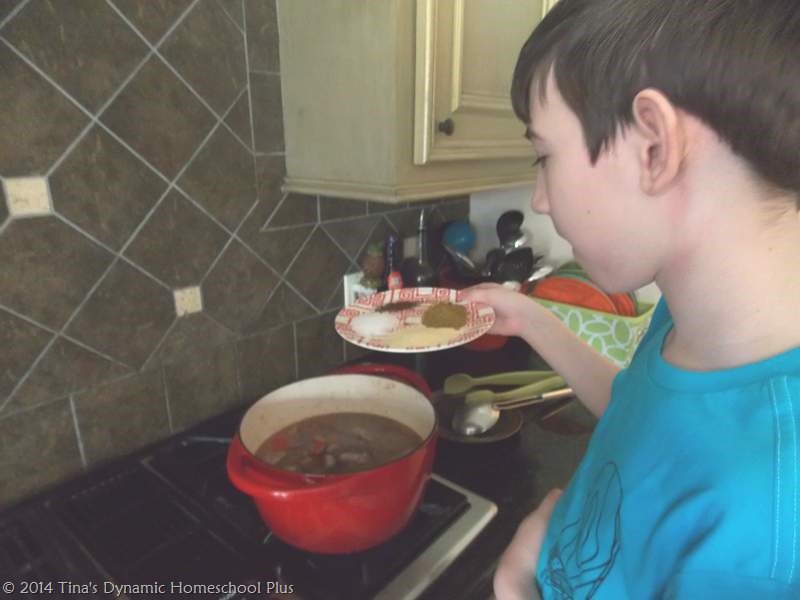
To go along with this poem, I thought I would teach Tiny how to make a simple Texas chili and you know spend a bit more time together.

Tx Unit 1Tx Unit 2

Too, we have had some cold weather that is almost unheard of in May so that called for home made Texas chili.  Well, I should say part home made. 

Any good Texan would make their beans from scratch, but canned beans are fine after we had a long day selling furniture in our house.

Easy Texas Homemade Chili

Here are some things we put in our chili:

  • 1 to 1 1/2 pounds of sirloin meat.  We are meat eaters.  Love the stuff.  This is a twist on our chili because we don’t use ground beef when we make it.
  • 1 onion, 1 jalapeno if I have it, some bacon for flavoring which makes any chili come alive.
  • About 1 tablespoon of cumino, 2 or 3 chopped garlic cloves, 1 teaspoon of chili powder, salt and pepper to taste.
  • 4 or 5 cans of pinto beans, though we use home made when we have them.
  • 1 can or 2 cans of Rotel Tomatoes, a bit of beef broth or beef bouillon.
Tx  Unit 3Tx Unit 4

Tiny and I share a love of cheese and a multiple assortment of delicious toppings over our chili when its cooked.

I like to add sour cream, tortilla strips,  avocado and the best recipe for home made salsa by Pioneer Woman.  I make that stuff by the bucket loads around here.

Free Copywork Cattle A Texas Poem For a Fun Unit Study

Trying to keep our school work light, this mix of homeschool lessons has been something I have not done before. 

I am finding it very gratifying to plan so spur of the moment and school on the wild and free side.  Sometimes you just a need a break from all the well laid out plans and sharing a bowl of hot Texas chili helps things too.

Free Copywork Cattle A Texas Poem For a Fun Unit Study

HOW TO GET THE FREE POEM COPYWORK

Now, how to grab the freebie. It’s a subscriber freebie.

That means when you sign up to follow me, you get my emails in your inbox and you get this freebie.

1) CLICK HERE ON THIS LINK TO SIGN UP ON MY EMAIL LIST & TO GET THIS FREEBIE.

2) Grab the freebie now.

3) Last, look for all my emails in your inbox. Glad to have you following me!

You’ll love these other resources too:

  • Texas Native American History Quick Unit Study (Middle School)
  • How to Build the Alamo: Day 5 Hands-on Learning (Free Texas Unit Study)
  • Exploring Edible Cactus: Day 4 Hands-on Learning (The Desert) – Eat cactus like the Coahuiltecan
  • Pioneer Living and Cloth Dyeing (Hands-on History)
  • 35 Simple But Powerful American History Homeschool Resources K to 12
Cattle by Berta Hart Nance Collage

6 CommentsFiled Under: 1. My FREE Learning Printables {Any Topic}, Hands-On Activities, History Resources Tagged With: copywork, freecopywork, hands on history, hands-on activities, handson, handsonhomeschooling, handwriting, homeschool, homeschoolanguagearts, language arts, languagearts, texasunit

Cursive Copywork Free Greece Poetry Printable

May 25, 2013 | 1 Comment
This post may contain affiliate links. For more information, please see my full disclosure policy.

I have a fun freebie today. It is cursive copywork free Greece poetry printable. Also, look at my page Practical Homeschool Writing Curriculum from Pre-K To High School for more tips.

I have done many things wrong when I first started homeschooling, but I have done a lot right too.

I tell my workshop new bees that writing or penmanship has always been the hallmark of a well educated man.

Cursive Copywork Free Greece Poetry Printable

One right thing was choosing the beautiful Calvert cursive to teach all of my sons. I know that a lot of public schools and homeschoolers are moving away from teaching cursive, but I am not one of them.

Maybe that is not so true today but if you want to peek into the past, you have to know at least how to read cursive to understand historical documents. I think reading cursive and writing cursive go hand in hand.

Too though I feel the time comes when you need to teach your kids typing skills.

Boys especially benefit from knowing how to type because they seem to struggle with learning how to write more so than girls. 

Penmanship is a time consuming skill to teach.

Between the struggles of a child and the time needed to teach, a lot of educators give up on it. However, I feel in homeschooling we do have the time to teach those skills.

Choosing Calvert script at a time when I had not a clue of what I was doing ended up being one thing that helped me not to struggle so much in this area.

After having taught Mr. Senior 2013 how to write in cursive, I just taught the other boys after that. I did venture out into other writing programs but came back to Calvert.

I came back to Calvert School cursive because it is a simplified cursive.

By the way, Calvert script is specific only to Calvert. They no longer sell it as a separate program and I believe the leader in cursive simplified cursive has gone all digital. (awful)

It is unique and I wished more people knew what a beautiful font and cursive it is. Too, it is neither D’Nealian or Getty Dubay but again a type of cursive used only by them.  However, I still base my teaching of cursive on the Calvert script as the gold standard.

Cursive Copywork Free Greece Poetry Printable

It is simplified because it teaches manuscript uppercase letters and cursive lowercase letters. I like the fact that it is free of the superfluous loops found on the traditional Palmer method.

Too, it is just plain pretty and simple as you can see from the chart above.

By the time Mr. Senior 2013 was in second grade, I knew how to teach cursive as you can see from his writing above.

My middle son struggled more because I ventured off into other writing programs. {Mea Culpa} That was the dumb thing I did but again he is fine. Kids are pretty hardy and let you know real quick what is not working for them.

Because I still feel like the same way as I did when I first started homeschooling about the importance of cursive, ALL of us will do copywork sometimes.  Me included. I keep a notebook beside my bed for me.  I never tell very many people that I pen a line or two also. 

Oh, I don’t write cursive as much as I use to. I use to write all their copywork out because the cursive font is not one you can find on computers or among fonts to purchase, but not so much anymore.

Copywork doesn’t take a long time and it’s a way of storing exquisite words in your mind and heart.

The benefits of copywork go beyond learning how to write. It gives you an overflowing amount of words and thoughts too. Especially when I do copywork from beautiful literature, I find it very satisfying and it leaves a lasting impression. Just a little each day is restoring.

MORE CURSIVE HANDWRITING TIPS

  • Teaching Cursive Handwriting Matters Style Doesn’t And Free Resources
  • Cursive and Free Greece Copywork Poetry
  • The Best Homeschool Handwriting Curriculum: Tips And Recommendations
  • Which One is Really the Best Homeschool Writing Curriculum (a comparison)

So when doing our unit study on Ancient Civilizations, I had prepare some copywork for Tiny.

I have hunted for a font that was similar to Calvert and came pretty close with the one I used in this copywork below. All of my sons know the Calvert cursive font but I still like to get pretty close.

The font is a little more slanted than I like but again close enough. The poem is Greece by Robert Frost. It is one of his more obscure and early poems. 

I like it because it’s by Robert Frost, one of my favorite poets. But also it gives a glimpse into his early writing and it shows his interest in history and idealization of heroic figures.

I thought this would go along with our Ancient Civilization unit so we are trying to commit this to our memory. Here are the beautiful words. Download your copy at the bottom.

ANCIENT GREECE POETRY FOR COPYWORK

They say, “Let there be no more way!”

And straightway, at the word,

Along the Mediterranean shore,

The call to arms is heard.

Greece could not let her glory fade!

Although the peace be in sight

The race the Persians was arrayed

Must fight one more good fight.

Greece! Rise triumphant.   Long ago

It was you proved to men

A few may countless hosts o’ver throw:

Now prove it once again!

Cursive, copywork, studying the classics and the co-op have all been on our mind lately.

What about you? Have you figured out the penmanship quandary yet?

HOW TO GRAB THE FREE GREECE POETRY COPYWORK PRINTABLE

Now, how to grab the freebie. It’s a subscriber freebie.

1) CLICK HERE ON THIS LINK TO SIGN UP ON MY EMAIL LIST & TO GET THIS FREEBIE.

2) Grab the freebie instantly.

3) Last, look for all my emails in your inbox. Glad to have you following me!

1 CommentFiled Under: 1. My FREE Learning Printables {Any Topic}, History Based, My Unit Studies {Free Printables & Hands-on Ideas}, Teach Homeschool Language Arts Tagged With: Ancient Greece, copywork, freecopywork, handwriting, homeschoolanguagearts, language arts, languagearts

  • « Go to Previous Page
  • Page 1
  • Interim pages omitted …
  • Page 11
  • Page 12
  • Page 13
  • Page 14
  • Go to Next Page »

Primary Sidebar

Footer

Privacy Policy | About Me | Reviews | Contact | Advertise

Categories

Archives

Tina Robertson is a participant in the Amazon Services LLC Associates Program, an affiliate advertising program designed to provide a means for sites to earn advertising fees by advertising and linking to amazon.com. As an Amazon Associate, I earn from qualifying purchases.

Copyright © 2026 · 5 TNT LLC · Log in · Privacy Policy
