• Facebook
  • Pinterest
  • Instagram
  • YouTube
  • LinkedIn
  • Skip to secondary menu
  • Skip to main content
  • Skip to primary sidebar
  • Skip to footer

Tina's Dynamic Homeschool Plus

Activity, Change, Progress

  • HOME
  • How to
    • Preschool
    • Kindergarten
    • Elementary
      • Geronimo Stilton Books
    • Middle School
    • High School
      • Science 
  • Planner
  • Lapbooks
    • Trioramas
    • History Games
    • LEGO
  • Shop
  • GET STARTED NOW!
    • Learning Styles
  • 7 Step Planner
    • Free Student Planner
    • Free Home Binder
  • Unit Studies
    • Creation to Ancients
      • Mesopotamia
    • Middle Ages to Reform
    • Exploring to Revolution
    • World Wars to Today
    • Science
  • Curriculum
    • More Unit Studies
    • Geography
    • Writing PreK to 12th
    • Free Art Curriculum
  • BootCamp
    • Resources
      • Ultimate Unit Study Planner

How To - - -

How Homeschool Learning Styles Helps You to Accept Each Child’s Differences

July 23, 2022 | Leave a Comment
This post may contain affiliate links. For more information, please see my full disclosure policy.

When I first heard about homeschool learning styles was when my first child was 5 years old. I wanted all the Homeschool Learning Styles tips I could get.

And 20+ years later there is still mixed science about how much difference learning styles really makes.

Today, I’m sharing how understanding homeschool learning styles of not only my children, but myself was a positive experience.

How Homeschool Learning Styles Helps You to Accept Each Child's Differences

Besides, the brain is such a fascinating machine and there is much to know about we learn.

Nobody can really be labeled with one hundred percent accuracy. We’re always learning and changing.

So, I will share how learning styles helped me to accept differences in my children.

And now that my children are young adults, I’m glad I trusted what I know about my children and educated myself about learning styles.

Further, I will help you to sort out terms because it’s not necessary to speak educationalese to have a starting place.

MORE HOMESCHOOL LEARNING STYLES TIPS

  • What Are the Top 5 Homeschool Styles
  • What Are the Homeschool Top Main 5 Learning Styles
  • How Homeschool Learning Styles Helps You to Accept Each Child’s Differences
  • How to Fuse Personality and Learning Styles to Choose the BEST Homeschool Curriculum
  • How Understanding Homeschool Teaching Styles Makes You Successful

Homeschool Style

First, this is the biggest point that helped me to understand learning styles.

And that is to move away from what a lot of educational institutions as well as universities identify as learning styles.

Without making this overly technical, a lot of professionals will write and speak about modalities.

It simply means how children or adults prefer to take in information.

Then, scientist and researchers have classified learners into kinesthetic (hands-on learner), auditory or visual.

How Homeschool Learning Styles Helps You to Accept Each Child's Differences

Also, some of that long standing research has changed to include one more group which is reading/writing. It is called the VARK model.

It stands for Visual, Auditory, Reading/ Writing, and Kinesthetic modalities for learning by (Fleming and Mills, 1992). 

However, the three major ones focused on for years are visual, auditory, and kinesthetic. As you can see right away this may or may not be helpful.

Because I was not a public-school educator prior to homeschooling, it was not helpful.

Beginning Point for Types of Homeschool Styles

Hence expanding on how these learning modalities help us teach at home is more important than understanding all the scientific in/outs.

So, instead of focusing on just the components of modalities, focus on your child’s learning personality. What is his learning personality?
This expanded view opened a whole another view of how to teach.
Switch from just learning style to learning personality. Again, this encompasses all the things that make your child unique.

In other words, look below on how I expanded the profile of each of my children to go beyond modality.

  • What is his interest?
  • Is he an introvert or extrovert?
  • Does he naturally flock toward others or prefer long periods alone?
  • Are interests nature based (not because you expose them to him), technologically oriented, or just prefers to read a book about all of it?
  • Does he prefer to just build instead of talk about it?
  • Is he competitive almost defiant?
  • How about inventing? Is that all that matters? His inventions?

These are a few of the questions I started asking myself about each of my children. I added these to their preferred way of taking in information or learning style.

In addition, I examined how I learned and taught my children. With my first child, I had no problem teaching him.

However, my second son came along and all that changed.

I wasn’t sure I was cut out to teach him because none of my tips with my first child seemed to work with him.

Then started my research to learn how to expand learning styles to learning personalities.

One of the best books to this day although it’s older is Discover Your Child’s Learning Style: Children Learn in Unique Ways – Here’s the Key to Every Child’s Learning Success.

Identifying Your Homeschooled Child’s Learning Personality

Finally, after years of putting the pieces together, I have created an online self-paced course on how to identify your homeschool child’s learning personality.

This course will give you solid beginning points and look what you will learn.

YOU WILL LEARN:

  • How to understand the way your child prefers to learn so that you can teach him in a way that he enjoys learning;
  • How to pinpoint your child’s learning personality;
  • A starting point in understanding (barring any special learning challenges or disabilities) and accepting your child’s preferred way of taking in information;
  • Understanding when the learning personality emerges; and
  • Teaching tips for each learning personality to stop the head-butting.
How Homeschool Learning Styles Helps You to Accept Each Child's Differences

And look at these other resources about learning styles
  • Homeschooling: Learning Styles – What’s the Difference anyway?
  • What Are the Top 5 Homeschool Styles

Leave a CommentFiled Under: Determine Learning Styles, Homeschooling Tagged With: classical approach, homeschool, homeschool learning styles, homeschoolapproach, learningstyles, unit study approach, workbook approach

How to Plan Your First Homeschool Year When You Don’t Know How To Start

July 22, 2022 | Leave a Comment
This post may contain affiliate links. For more information, please see my full disclosure policy.

I’m sharing 4 tried and true ways how to plan your first homeschool year when you don’t know how to start. And having the right homeschool planner for your first-year matters.

You’ve left traditional school and your planning should now reflect your new homeschool life you’ve adopted.

However, your first year of homeschooling can be daunting for many reasons.

At the top of the list of concerns are how to find curriculum and how to plan.

How to Plan Your First Homeschool Year When You Don't Know How To Start

Also, knowing what is important now to plan your new homeschool year and what can wait matters.

In addition, you’ll want to make changes throughout your first year.

Why? Now that you’re 1:1 tutoring you will have an excellent grasp on what your children truly know and don’t know.

Homeschool Planning

First, this is the BEST piece of advice although some do not want to hear it.

How to Plan Your First Homeschool Year When You Don't Know How To Start

Do not buy curriculum – yet.

Not only do I want you to have an incredible start, but want to help you save hundreds if not thousands of dollars too.

So before you can choose curriculum, you need to understand where to find it and how to choose it.

The point I’m making is that it’s just as important to know what not to do.

So, don’t let doubts, fears, and misconceptions keep you from making your first homeschool year memorable for the right reasons.

Too, it will take time to not only learn where homeschoolers hang out at, but to understand the new lingo.

CLICK HERE TO GRAB THE FREE GLOSSARY OF HOMESCHOOL LINGO
BECAUSE YOU WANT TO BE WAY AHEAD AND NOT STRUGGLE

After you grab the lingo to understand terms in the homeschool world, look at these 4 best ways to begin your year.

4 BEST Ways to Plan Your First Homeschool Year

First, know your local law, but also know how to meet it.

It’s one thing to read it but quite another thing to homeschool with the nuts and bolts of it each day.

Too, some homeschool laws are very relaxed and a first-time homeschooler may want more details.

However, know that with relaxed laws comes much homeschool freedom.

1. Know Your Local Law AND How to Meet It.

On the other hand, some states have very strict laws. Again, be familiar first with your local state law.

You can find out your state law in two ways;

  1. Find your state’s laws on this page with HSLDA and/or
  2. ask me right here or email me at tinahomeschools at gmail dot com. I’ve helped HUNDREDS get on the road to homeschooling and stay on it. I can help you too.

Next, it won’t take long to understand what is deschooling.

I know you’re eager to get started, but taking just a few days to make your foundation strong will benefit you your whole journey.

How to Plan Your First Homeschool Year When You Don't Know How To Start

Not only do I have a wonderful video for you, but I have this post

2. Don’t Set Up Your Home Like a Public School Classroom. Deschool Next.

Taking your kids out of public school one day and begin homeschooling the next day is a common rookie mistake.

At this point, take time to change to a relaxed mindset and clearly understand how a homeschool method is VERY different from a traditional public school approach.

If you don’t want to repeat the same mistakes at home that weren’t working in public school, you need to know how to deschool.

Thereafter, you want to move quickly to understand how homeschool curriculum is organized.

3. Save yourself HUNDREDS of dollars by knowing how curriculum is organized in the homeschool world.

Having a basic grasp of the top 5 approaches, new homeschoolers can conquer overwhelm and tame the curriculum beast.

And my post Top 5 Homeschool Approaches New Homeschoolers Need to Know will help you get started.

Also, look at my online self-paced course Teaching the Stages of Homeschool. You’ll learn From PreK to High School, Learn at a Bird’s-Eye View of What Subjects to Teach & When to Teach Them

Finally, the best way to begin with choosing curriculum is to begin with free to inexpensive curriculum.

4. Begin teaching your children with inexpensive curriculum until you know how your children learn best.

As I mentioned the outset, you’ll have a better pulse on how your children learn best, but until you tutor you don’t know their strengths and weaknesses.

Also, I have my first time homeschooler kickstarter course.

Moreover, here are more posts t0 help you.

  • 5 Ideas to Kick-Start Your New Homeschool Year By Including Others
  • BEST Free Kindergarten Homeschool Curriculum With A Gentle Approach (List)
  • It’s a New Homeschool Year and My Child Wants to Go Back to Public School
  • Get Organized – Rev Up for the New Homeschool Year
  • Free Middle School Science Curriculum and Magazine,
  • and Free Middle and High School Homeschool Language Arts.
How to Plan Your First Homeschool Year When You Don't Know How To Start
CLICK HERE TO GRAB THE FREE GLOSSARY OF HOMESCHOOL LINGO
BECAUSE YOU WANT TO BE WAY AHEAD AND NOT STRUGGLE

Resources in How to Plan Your First Homeschool Year

  • Top 10 Tips To Getting a New Homeschool Year Rolling
  • When You Don’t Know Where to Begin in Homeschooling. The 3 R’s for New Homeschoolers. Part 2
  • The Ultimate Guide for New Homeschoolers – An Easy Beginning!

Leave a CommentFiled Under: Homeschool Planner, Homeschooling, Lesson Plan, New Homeschooler Help, Schedule/Balance Home & School Tagged With: curriculum pages, curriculum planner, homeschool curriculum planner, homeschoolplanner, homeschoolplanning, lesson planner, lessonplanning, new homeschool year, new homeschooler, new homeschooler homeschool organization, newbeehomeschooler, planner, planning

How to Effortlessly Blend Kindergarten Homeschool Subjects & Life

July 21, 2022 | Leave a Comment
This post may contain affiliate links. For more information, please see my full disclosure policy.

Blending kindergarten homeschool subjects and life doesn’t make it easy to determine kindergarten homeschool curriculum.

However, today I’m helping you to know how to effortlessly blend the kindergarten subjects with what you’re doing naturally every day.

Further, don’t forget up to this time you have not used any curriculum in your instruction.

Sometimes very little kindergarten homeschool curriculum is needed.

In addition, families vary in their needs, but all children benefit from a gentle and relaxed approach to the kindergarten homeschool subjects.

How to Effortlessly Blend Kindergarten Homeschool Subjects & Life

Moreover, it’s important to build a strong foundation for lifelong learning.

And it begins what the subjects that are foundational and the subjects that can be folded into your day naturally.

Beginning my journey 20+ years ago, I didn’t have to make a choice about common core and by the time the No Child Left Behind act was passed, I was well on my way to homeschooling.

Because the educational world can be muddled to trek through, I will give you a glimpse of what is important at this age.

Essential Kindergarten Subjects

Too, it’s important for you to first to know what subjects you need and want to teach.

1. Begin with the subjects your local homeschool law requires.

First, begin with your local law.

No, you don’t choose homeschool curriculum first because your local law could be relaxed or it could be rigid. And your curriculum can help or hinder you meet state law.

Choose curriculum after you’re familiar with the subjects you must teach.

2. Second, focus on math and language arts which are your essential subjects

Then, know what are foundational subjects for kindergarten.

Although curriculum companies tout that you need all subjects, the truth of it is that math and language arts are the key components.

How to Effortlessly Blend Kindergarten Homeschool Subjects & Life

But, I know you want details because that is what I needed to when teaching my first child.

What’s more look below at this list to see what skills you need to focus on.

ESSENTIAL SUBJECTS IN KINDERGARTEN
MATH | LANGUAGE ARTS (Tip: The subjects vary by age and grade.) For Kindergarten, the subjects are Reading, Phonics, and Writing.

SKILLS TAUGHT IN MATHSKILLS TAUGHT IN LANGUAGE ARTS
Know the ordinal numbers up to 10, but recite numbers to 100Names the parts of a book like cover, back, and inside pages. Understands which direction to hold the book And knows that a story has a beginning, middle and ending .
Knows how to compare two groups to understand the more than, less than and equal to.Recognizes the letters of the alphabet and understands that the letter represents sounds.
Recognizes shapes, and understand patterns ABC, AABBCC, ABBCC, ABAB, etc.
Identifies money.
Is familiar with conventional measuring tools like rulers, but starts with unconventional tools like a pencil.
Can see that we read right to left and top to bottom. Associates sounds with symbols for writing and begins with inventive writing which letters can be indistinguishable. And practices adding new words to his vocabulary.
Compares objects based on size and capacity.Can retell stories and can even act them out.
Counting by 10s and understands what is a pair.Begins to learn and recognize signs from his community like stop signs, etc.
Is familiar with a clock and the numbers on it.Recognizes his name and attempts to “write” it.
Becomes familiar with word that represent position like under, through, on top of, etc. Also, begins basic addition and subtraction by learning how to group sets and break them apart.Begins to sound out and read CVC words like cat, rat, and sat.

3. Decide how to pair kindergarten subjects with life skills.

Next, look at these skills above which are normally introduced in curriculum through a scope and sequence or order.

Kindergarten Subjects

So, you can either use a laid-out curriculum or continue to do what you’ve been doing up to this time in your child’s life.

For example, look at how I effortlessly blended the kindergarten homeschool subjects with life skills.

  • Reading aloud increases your child’s vocabulary, ability to retell, and encourages him to act out what he has learned.
  • Point out words or signs in your home and community to explain their meaning and what they say.
  • Provide plenty of pictures books to your child to look at and dream about.
  • Plant a garden to cover science, measuring, and “write’ on plant markers.
  • Instead of using the app on your phone, have your Kindergarten help with a grocery list.
  • Encourage your kindergarten to understand money by adding some to his piggy bank and paying for small items with your supervision.

  • Beautiful and Flexible Early Learner Homeschool Planner

    Beautiful and Flexible Early Learner Homeschool Planner

    $7.25
    Add to cart
early learner planner

Kindergarten Homeschool Ideas

Also, here are more ideas of things you’ve probably already been doing.

  • Take care of a pet and learn to measure the pet’s food or medicine.
  • Practice and recite rhymes. Rhymes are not just child’s play but the foundation to hear rhyming and syllables of a word. These skills are the beginning of phonics. Eventually, the sounds will be put to writing to learn spelling. It’s important to rhyme.
  • Use paint brushes, q tips, sticks, to ‘”write” with.
  • Bake cookies and learn fractions and the measurements on the cups.
  • Take a nature walk and look for patterns in nature. For example, look at the repeating patterns of petals and the seeds in the head of a sunflower.
  • Do crafts and make a clock with moving hands.
  • Play games like uno and dominoes to learn number and additions.
  • Use popsicle sticks and glue on 10 beans and use as a counter for 10s, 20s, and etc.
  • Use these fun rock crayons which encourage the correct grip prior to holding a pencil.
How to Effortlessly Blend Kindergarten Homeschool Subjects & Life

Moreover, as you can see all of this can be done without worksheets. Puzzles, play props, and play-doh should still be part of kindergarten.

Do not give up what you’ve done for the first five years of your child’s life. Learning doesn’t always have to be divided into subjects.

Finally, if you need a curriculum, remember to use it as a framework, but do not make it the ultimate way a child learns.

What things are you naturally doing with your kindergartner each day where you’re blending learning and living?

How to Effortlessly Blend Kindergarten Homeschool Subjects & Life

Other Kindergarten Homeschool Curriculum Resources

  • Homeschooling Kindergarten: What Subjects to Teach and For How Long?
  • Delightful Kindergarten Homeschool Curriculum Which Promote a Love of Learning
  • 21 Fun All-In-One Kindergarten Homeschool Curriculum
  • BEST Free Kindergarten Homeschool Curriculum With A Gentle Approach (List)

Leave a CommentFiled Under: Homeschooling, Teach Kindergarten Tagged With: homeschool subjects, homeschoolanguagearts, kindergarten, language arts, languagearts, life skills, skillsubjects

Easy and Fun Who Is Geronimo Stilton Rodent Notebooking Page

July 20, 2022 | Leave a Comment
This post may contain affiliate links. For more information, please see my full disclosure policy.

Today, I have an easy and fun who is Geronimo Stilton rodent notebook page. I’ll be adding more activities for the series of Geronimo Stilton books.

The series of books are delightful and cute, but parents and families have mixed reviews.

Since I don’t encourage a lot of formal writing in the early years, but I do encourage tons of reading, I love these books.

Easy and Fun Who Is Geronimo Stilton Rodent Notebooking Page

So, this easy free printable is geared toward the same ages as the book which is 7 to 10 years old.

But between you and I, it’s such a fun series that your older reluctant readers will be drawn in by the humor.

In addition, I wanted the printable simple so that you could either introduce a younger reader or a reluctant reader to the books.

Besides, as I mentioned I don’t want your young children thinking that tons of writing needs to always be associated with reading.

Moreover, read my post here 10 Fun Things You Can Teach Using Geronimo Stilton Books to help your child use the notebooking page.

Geronimo Stilton Books

Too, I was first introduced to the books a few years back when I was looking for a series for younger kids in our group.

And I was pleasantly surprised by all the adventures and mouse action in the Geronimo Stilton series.

Too, it took me a bit to sort out who is the writer and how the series unfolds.

However, let me share a few things to make your search for this easier.

  • Mouse in Space!
  • The Missing Movie

First, Geronimo Stilton is the editor of a newspaper.

The books have colorful fonts and pictures. And of course he spends part of his time solving mysteries, chasing adventure and satisfying his love for cheese rinds.

And as the Scholastic website says, “Geronimo Stilton is the publisher of The Rodent’s Gazette, Mouse Island’s most famouse newspaper.”

  • The Hawaiian Heist
  • The Curse of the Cheese Pyramid

The series is written by an Italian author, Elisabetta Dami, but there are many spinoffs now. However, Geronimo Stilton is the original series.

Easy and Fun Who Is Geronimo Stilton Rodent Notebooking Page

You can read about how Ms. Dami created Geronimo Stilton.

Author of Geronimo Stilton

I found Ms. Dami’s thoughts moving on how she created a shy, tender and clumsy mouse.

And another fun reason I really adore the books is that there are many references to geography and history because of Ms. Dami’s passion for archaeology.

So, these make for great supplements for your elementary kids to my history or science unit studies.

In addition, be careful when you choose the books. There are many spinoffs and the books are in black and white.

The original series have color pictures with colorful words and fonts.

Add in some fun bookmarks and your young reader will love these books.

Too, if you’re reading these fun books aloud, grab the read aloud tracking form.

  • Awesome Reading Aloud Tracking Time Homeschool Form

    Awesome Reading Aloud Tracking Time Homeschool Form

    $2.75
    Add to cart

Look at these other tips for books and reading you’ll like.

Books and Games for Beginner Readers

  • 12 of the Best Books For Beginner Readers Being Homeschooled
  • 6 Boy Approved Books Which Spark the Love of Reading
  • 5 Steps to Choosing Geography Living Books Your Children Will Love
  • How To Get Your First Homeschooled Child Reading
  • 6 Tricks for the Kid That’s NOT in Love with Reading!
  • Homeschool Colorful Reading Journal to Motivate Kids
  • Best Reading Games for Boys

Another point I want you to know about the book is that there are funny spellings.

Also, there are play on words or unique spellings where there is substitution with some form of the word mouse.

For example, instead of the text fabulous, it’s written fabu-mous. This can be confusing for the young reader or for some they find the humor in it. Again, this depends on the maturity of your reader.

I think for some 7-year-olds the unique spellings would be too much.

By the way, Lost Treasure of the Emerald Eye is the first book in the series if you want to start from the beginning, but it’s not necessary in this series.

However, you can use that as a teachable moment to explain the right word.

Of course if you’re reading aloud to a younger reader, he may not understand the play on the word. I’ve found that such saying the correct word and moving on is best.

Easy and Fun Who Is Geronimo Stilton Rodent Notebooking Page

Soon, your child will understand the funny passages. Like I mentioned I have more ideas coming to use for some of the books.

Which book is your child’s favorite? And old is your reader?

Now, how to grab the freebie.  It’s a subscriber freebie.

HOW TO GET THE FREE GERONIMO STILTON NOTEBOOKING PAGE

That means when you sign up to follow me, you get my emails in your inbox and you get this freebie.

1) CLICK HERE ON THIS LINK TO SIGN UP ON MY EMAIL LIST & TO GET THIS FREEBIE.

2) Grab the freebie instantly.

3) Last, look for all my emails in your inbox. Glad to have you following me!

Leave a CommentFiled Under: 1. My FREE Learning Printables {Any Topic}, Teach Homeschool Language Arts, Teach Kindergarten Tagged With: books, elementary, Geronimo Stilton, reading, readingcomprehension

Day 1 Learn The Lingo and New Homeschooler Free Bootcamp (& free glossary)

July 18, 2022 | 13 Comments
This post may contain affiliate links. For more information, please see my full disclosure policy.

Today is day 1: Learn the Lingo of the homeschool world in the free 31 Day Free Boot Camp for New Homeschoolers.

Congratulations on your new beginnings as a new homeschooler. It’s an exciting journey for sure. I wrote this series well over 9 years ago.

Not only am I updating this free first time homeschoolers series, but I’m sharing some of the best ever homeschool resources.

For day one, I’ll be sharing why it’s important to start with how to find the information you need.

Day 1 Learn The Lingo and New Homeschooler Free Bootcamp (& free glossary)

Many new homeschoolers begin their journey thinking the public school world and our homeschool world are similar.

They are not. You’ll need to know how to navigate the homeschool world.

And that begins with knowing new terms to you but that we speak everyday in the homeschooling world.

First, I want to share a story with you which will help you to appreciate that you have to have some skin in the game.

New to Homeschool

Have you ever heard the butterfly story? The short version is that a little boy runs to tenderly cut open a cocoon to help the struggling butterfly emerge.

Even though he had good intentions to assist the butterfly, the butterfly’s fragile wings never expanded.

The butterfly just walked around with a swollen body, shriveled wings and never did learn to fly.

Struggling was part of the empowerment and essential to the development of the butterfly.

As a seasoned veteran, I want to make your beginning less difficult with this 31 day free new homeschooler boot camp.

However, just like the beautiful butterfly which emerges from a struggle, your struggling with various homeschool issues will empower you.

Most people don’t want to hear that, but if you think about your parenting journey it’s similar to that. We do as much as we can to prepare for our first child.

However, nothing compares to the personal experience of raising a family.

As you emerge and face each issue, I want the topics in this series to be a soft place for you to land when you become overwhelmed.

The best way for me to do that is start from the beginning on what I feel you need to know.

Based on my many years of personally helping new homeschoolers and conducting workshops through my new bee program.

Who is Tina Robertson

But before you can appreciate how I can help you here are are a few things about me. Sure, this free new homeschooler boot camp is all about you.

However, you need to know that I’m not new to the homeschool world.

Too, I have 3 homeschooled grads. So I’m well past having my oldest kid being 10 years old.

But the best part is that what I have for you works.

Also, look at a few other things about me.

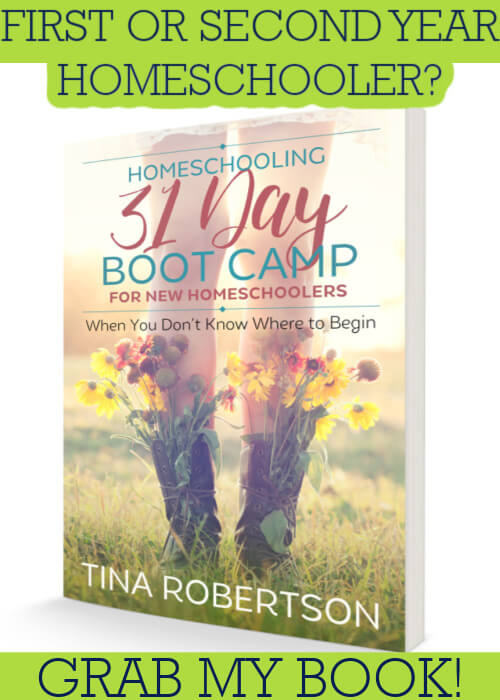
  • I am the author of the book Homeschooling 31 Day Boot Camp for New Homeschoolers: When You Don’t Know Where to Begin

And I have a detailed self-paced online homeschool Kickstarter course. It is a detailed comprehensive course for first time homeschoolers.

That is enough about me.

This new homeschoolers free boot camp is about you. I’ve not only been helping new homeschoolers in person, but here at my site for years.

Let’s dive in because I know that your questions in the beginning focus mainly on one topic and that is choosing curriculum.

Having curriculum is viewed as the hallmark of homeschooling.

And I have much to tell you on how to select it.

However, I would be doing you a great disservice if I jumped right to that topic without building in you an appreciation of the homeschooling world.

You can’t come to appreciate all the facets of the homeschooling world if you cannot communicate with us and talk the talk.

Key to extracting answers to your questions during your journey is to use and know homeschool lingo.

New Homeschoolers's Glossary of Terms

So, I have a gift for you. It is a printable glossary of homeschool terms.

This will get you well on your way to minimizing the struggle and maximizing your time.

Day 1 Learn The Lingo and New Homeschooler Free Bootcamp (& free glossary)

Be sure to grab the download of homeschool terms you will be hearing now and from on. They will help you get on the road to homeschooling and stay on it.

CLICK HERE TO GRAB THE FREE PRINTABLE OF HOMESCHOOL TERMS BECAUSE YOU WANT TO BE WAY AHEAD AND NOT STRUGGLE

Day 1 Learn The Lingo and New Homeschooler Free Bootcamp (& free glossary)

5 Days of a Homeschooling Co-Op
Day 1: Learn the Lingo – Then Go! {31 Day Blog Boot Camp For New Homeschoolers}

Save

13 CommentsFiled Under: 31 Day Blog Bootcamp for New Homeschoolers, Begin Homeschooling Tagged With: bootcamp, homeschool, homeschool challenges, homeschoolchallenges, new homeschooler

  • « Go to Previous Page
  • Page 1
  • Interim pages omitted …
  • Page 38
  • Page 39
  • Page 40
  • Page 41
  • Page 42
  • Interim pages omitted …
  • Page 128
  • Go to Next Page »

Primary Sidebar

Footer

Privacy Policy | About Me | Reviews | Contact | Advertise

Categories

Archives

Tina Robertson is a participant in the Amazon Services LLC Associates Program, an affiliate advertising program designed to provide a means for sites to earn advertising fees by advertising and linking to amazon.com. As an Amazon Associate, I earn from qualifying purchases.

Copyright © 2026 · 5 TNT LLC · Log in · Privacy Policy