• Facebook
  • Pinterest
  • Instagram
  • YouTube
  • LinkedIn
  • Skip to secondary menu
  • Skip to main content
  • Skip to primary sidebar
  • Skip to footer

Tina's Dynamic Homeschool Plus

Activity, Change, Progress

  • HOME
  • How to
    • Preschool
    • Kindergarten
    • Elementary
    • Middle School
    • High School
      • Science 
  • Planner
  • Lapbooks
    • Trioramas
    • History Games
    • LEGO
  • Shop
  • GET STARTED NOW!
    • Learning Styles
  • 7 Step Planner
    • DIY Best Student Planner
    • Free & Easy DIY Home Management Binder
  • Unit Studies
    • Creation to Ancients
    • Middle Ages to Reform
    • Exploring to Revolution
    • World Wars to Today
    • Science
    • Free Art Curriculum Grades 1 – 8
  • Curriculum
    • More Unit Studies
    • Geography
    • Writing PreK to 12th
    • Geronimo Stilton
  • BootCamp
    • Resources
      • Dynamic Subscriber Freebies
      • Exclusive Subscribers Library
      • Ultimate Unit Study Planner

hands on history

Beware of the 3 C’s of Lapbooking

February 23, 2014 | 21 Comments
This post may contain affiliate links. For more information, please see my full disclosure policy.

Would you believe me if I told you after creating more than 30+ lapbooks with my children {I have lost track} that using lapbooks in our homeschool seemed like a turn off to us when we started homeschooling?

Today, using lapbooks as enrichment in our every day unit studies have kept them a delight and not overwhelming our day.  My journey did not start off that way. 

Beware of the 3 C's of Lapbooking

I made three basic mistakes when I initially folded in (corny pun I know) lapbooks into our day.

If you are the non-crafty person and have been avoiding creating a lapbook  with your kids, hopefully steering you clear of my mistakes will nudge you to try one or two.

I had to have an attitude adjustment first and I have to confess about it now.

  I knew that my kids were not the crafty loving (or so I thought) type of kids and I knew lapbooks were for those “other” homeschoolers.  You know the ones who pine to do crafts all day.

Interactive Tool or Time Waster Tool?

I just knew that lapbooks were more about crafts than conscientious and diligent learning. 

Because crafts are at the opposite end of my personality style or I should say as I understood crafts to be at the time, I missed out on several years of creating lapbooks with my older son.

Fast forward about five years after that thinking, my teaching methods were boring and blah. 

I knew worksheets didn’t take long for my children to do (I admit it, I was bad because that is all we did) and they took even less time for my children to forget about them.

Moving out of my comfort zone and wanting our homeschool journey to be a memorable one, I knew the hands-on element was missing in our every day learning. 

I wanted to capture that element of learning for my sons and gradually did more research on lapbooks.

Slowly, I started to see that the greatest benefit to my children about lapbooks is that they are a fantastic interactive learning tool. 

The interactive part to opening/closing the minibooks, turning the circle minibook and folding/unfolding to read information is much like— well— the learning that is done in museums.

Why did we prefer a day at the museum over doing a worksheet? 

Museums are a fun place to visit not because you look forward to doing a worksheet when you get there. 

Learning can be done informally and at your child’s pace while he presses buttons for information to light up, turns a wheel for more information, listens to the information and otherwise follows along to see the exhibits and read the information. 

Even adults still like this part of a museum. 

We never out grow a museum.

Beware of over Crafting!

Lapbooks are like a mini museum in a file folder.  Redefining my meaning of crafts, I first tried several months of crafts or I should say over crafting. 

I almost gave up because I tried to be something I was not and my boys weren’t having fun either.

When we would rather read something from a book than glue a bean on a paper, I knew I went too far the other way in trying to incorporate crafts.

Beware of Coloring!

That wasn’t the only mistake I made.  I remember when my sister who has all girls would meet up with us to school together when our kids were preschool.

Lapbooking Can Be for the Non Crafty Kid and Mom too!

Her girls would sit so patiently and sweetly as they couldn’t wait to color, doodle and create.  My boys ran from coloring and were outside using tree branches for swords on each other. 

Both my sister and I had a lot to learn as new teachers because we both thought the other family had something “wrong” with their kids.

Because I know boys learned differently and needed to strengthen their fine motor skills, I realized coloring was just one way to do it, not the only way.

As I created lapbooks, I understood the way my boys learned. 

For my sons the fun is not necessarily in coloring pictures so I added more and more pictures or clip art already colored to my lapbooks.

They could focus on learning the content, folding the books, and if they wanted to, they could do something crafty for the outside file folder flap. 

Still to this day, I add in color pictures and coloring pages so if the mood strikes they can choose either option or a combination of both. 

I didn’t restrain their creativity, but gave them options when they didn’t want to be.

Beware of Cutting!

I had already made two mistakes and this last mistake which was throwing a gazillion pages at my kids to cut actually did make us move away from lapbooking for a few months.  

In doing school, I had to remember I wasn’t teaching scissor skills necessarily.

minibooks - emphasize the writing and not the scissor cutting

There is nothing about cutting out minibooks that inspired my children to want to do another lapbook.  Quite the opposite, they wanted to run from it and I did too.

Realizing that I was not teaching my sons how to cut when we did lapbooks, I did a majority of the cutting for my sons in the early grades. 

What a breath of fresh air as we sat down to start the next lapbook because most of the pages were cut.

This is perfectly okay to do.  Just like any teacher would prepare flashcards or some other hands-on manipulative for her classroom, this was the part I did as a teacher for them.

 Even as they got older, I still help with cutting out the minibooks.

Focusing on my family, I redefined the meaning of crafts in our home.  Crafting now in my mind equates with hands-on and it can be virtually anything that your children enjoy doing. 

  It really is that easy and I had to understand that sometimes the house doesn’t always have to be a mess to enjoy them.

Today, my mind races with hands-on ideas, but I always weigh them against what my sons will really find delight doing and weigh the value of it against the concept I want them to learn.

Whether you have kids who desire to do crafts all day or run from them, you can still lapbook.  Adjusting lapbooking to work for your family is key to savoring them.

I certainly don’t consider myself a true lapbooker if there is such a thing.  Why?  Because the crafts, cutting and coloring are not reasons we weave them in our day.  While maintaining a hint of my classical roots while we do a fun hands-on easy lapbook, I have found a way to not miss out on something that brings learning alive for us.

It doesn’t have to be either or when you choose an approach to homeschooling, it just has to be good for your family.

Do you want to give lapbooks a try? Try one or two easy ones.

I have made it easy for you, I have divided  up my lapbooks by history time period or science topic.

Pssst..They are ALL free too!

Hugs and love ya,
21 CommentsFiled Under: How To - - -, Lapbook, Lapbooks Tagged With: hands on history, hands-on, hands-on activities, handson, handsonhomeschooling, lapbook

Free Machu Picchu Mini Book & Completed South America Lapbook

November 15, 2013 | 3 Comments
This post may contain affiliate links. For more information, please see my full disclosure policy.

I think  we have exhausted our reading about Machu Picchu for our South America unit study.

Free Machu Picchu Mini Book & Completed South America Lapbook

Free Machu Picchu Mini Book & Completed South America Lapbook

There was plenty of free information online for this subject and then with a little pinch of information from our geography textbook I got this year, we had enough to cover this topic lightly.

South America Machu Picchu

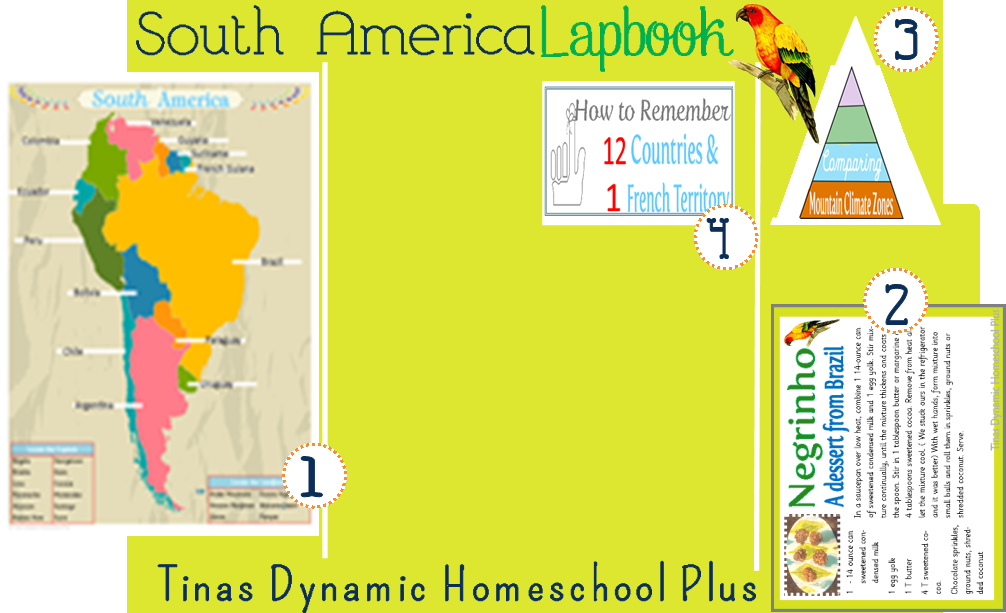
South America Lapbook

I think we have satisfied our appetite about South America for now and have our lapbook to go with it. 

Like all of my unit studies, we can visit them anytime we decide and add in more information.

I hope you enjoyed tagging along with us on this unit study. I will let you know soon what we have decided to scoot on to next.

South America Printable Minibooks

Also, look at these minibooks which come in the free South America lapbook 27 page download.

  • Animals of the Galapagos fan book which includes the Giant Tortoise, Lava Lizard, Marine Iguana, Green Turtle, Galapagos Penguins, Magnificent Frigate Bird, Blue-Footed Booby, and Blue-Banded Goby.
  • Comparing Mountain Climate Zones
  • Simon Bolivar Copywork
  • Map of South America to label and one labeled
  • Machu Picchu – Lost City of the Inca
  • Negrinho – A dessert from Brazil
  • How to Memorize the Countries of South America and Dependent
  • Map Flags to put on your salt dough map
  • 2 – The Galapagos Island layered book. One prefilled with facts and one blank to add your own information.
  • Vocabulary Pocket and Vocabulary Words

More South America Unit Study Resources

  • Appreciating the Culture of South America Through Dance
  • 6 South America Country Notebooking Pages
  • How to Memorize the Countries of South America & Mountain Climate Zones Minibooks
  • South America Unit Study– Colorful Free Printable Map
  • South America Geography Salt Dough Map + Printable Pennants
  • South America Unit Study resources

How to Get the Free South America Printable Lapbook

Now, how to grab the free lapbook. This is a subscriber freebie.

That means when you sign up to follow me, you get this freebie.

 1) Sign up on my list.
 2) Grab the freebie now.
3) Last, look for all my emails in your inbox. Glad to have you following me!

Ocean Currents and The Galapagos1

3 CommentsFiled Under: 1. My FREE Learning Printables {Any Topic}, Geography Based, Science Based Tagged With: hands on history, hands-on, hands-on activities, handson, handsonhomeschooling, machpicchu

8 Ways to Teach Homeschool History Other Than Chronologically

November 2, 2013 | Leave a Comment
This post may contain affiliate links. For more information, please see my full disclosure policy.

My homeschool roots are in classical education because so many things just chimed true and made complete sense to me like covering history in chronological order when I first started homeschooling. 

Too, my own education in high school mostly focused on American history with no real start in early civilizations or Bible. So when I answered part of Laura’s question on Should Homeschool History Be Covered in Chronological Order, I just had to expand on it. 

I know my family has reaped many benefits for following an organized cycle, whether a curriculum provider does that in 3 or 4 years. 

On the other hand, after that history has to have life or you can lose interest in repeating the same story line.

History is an adventure to say the least because there are so many action packed stories and other side show events or people’s lives that are running parallel to each other that eventually you want to stray off that organized cycle to explore some of the sideshows. 

Because children take in a lot more than we give them credit for at times, I don’t feel it confuses them but infuses them for a love of history when we take time to cover history in other ways.

Humdrum History

Before I list other ways to teach history, look below to understand how to maximize these other ways in your journey. 

  • They work for families who have just taken their kids out of public or private school and are feeling overwhelmed and burned out.
  • They work for families too who have been homeschooling for a while and have hit the humdrum of history. Sometimes you just need a new bounce or spring to your history studies.
  • They work for families that savor history and want to cover it in more depth and for gifted learners who need more substance.
  • Some of the ways work for families who have special needs children who learn through different senses;
  • And depending on the resource, they work for families who have very young children and may not really get the benefit of understanding chronological order or care how the Egyptians kept time before clocks were invented.

History Confusion or Infusion?

Look at the approaches below, all of which I have done at some time or another though  new curriculum has come along.

1. Teach History Through The Lives of Characters. Though this may seem like a literature approach because you are using great literature, it is not. 

A literature approach uses many great books and focuses on many topics of a time period. Teaching history through the life of a person that lived in that time period focuses on events that affect your main character. It is more in line with taking a biography approach to history.

This is how we cover history presently. My very favorite set of books for older kids that we wallow in as much as we can are the books by Genevieve Foster by Beautiful Feet.

These are keepers in my homeschool and ones we never tire of reading. When you learn that Daniel Boone was a little boy growing up at the same time as George Washington, then you appreciate the impact both made on American history.

For younger kids, it is very easy to find books or biographies on famous people like George Washington and for girls like Pocahontas. Another keeper for younger grades is the D’Aulaire collection by Beautiful Feet too.

The American Girl dolls are also a fun way to learn. I think about Native Americans with the Kaya doll. Look here at a page for crafting with dolls.

Make history meaningful by reading the lives of real people with lively literature.  Too, this way is one I feel is better to teach real young kids because they remember people easier than understanding what time period they lived in. There is not a  lack of literature on most famous persons of history and enough to choose from for kindergarten to high school age.  

2. Teach History Through Art. In classical education, art and science are tied into the time period you are studying. However, art does not have to be studied that way.

When history can be learned along with something else that your child loves, it makes it more meaningful. One curriculum that does this is Visual Manna.

Another example is Mapping the World With Art. Geography and history are inextricably linked as it should be and you learn while you watercolor or make maps.

(Source Joy Hakim)

3. Teach History Through Science. For science lovers who need to learn a bit of history through a science brain, Joy Hakim has a series called The Story of Science that we are going to try next. I have seen rave reviews and talked to homeschoolers who used it.  This is a secular source. Sometimes for me that is a good thing so I can add my own Bible content, but many times too it means they tout a no need to believe in God or an evolutionary belief which is contrary to what I want my children to learn. But as homeschoolers I don’t think any of us are not use to tweaking curriculum for our beliefs and worldview. So I will address our belief in creation and dependency on the Creator with my children. From what I have seen the story is so engaging that it is worth the time to tweak those parts. This is another way for us to sneak in some more science with history that we love. Since we haven’t read these yet, the jury is still out on this.


4. Teach History Through Drawing. Children have a natural disposition toward drawing and doodling. So encourage that. Some grow up to draw beautifully.  Mr. Senior 2013 was like this and I used Draw Write Now for him when he was younger.


(Source:Rainbow Resource)

Then also came along Draw and Write Through History which we have used too and love.


The History in Scribe is another fun way to learn about historical events and writing and drawing about them too. This can be used for a child that you expect a little more writing from. There are a lot of free notebooking pages, mine included, where ample space is left for visual diagrams. As you can see, you don’t even have to have a curriculum, just an imagination. For example, a child can draw the flora and fauna that Lewis and Clark saw along their expedition. Then a love for history beyond boring dates that makes me yawn too is revived. They also have a beautiful nature journal to keep as well.

Too, if you have a child delayed in motor skills or a reluctant writer, then drawing is a fun way to engage them, build motor skills AND teach history.


Let go of ALL that thinking that history has to be taught a certain way when you need to and trust your mommy gut on what is best for your child. They will not forget it as they grow older or what you taught them.

5. Teach History By Topic. Though this may sound like a unit study it really is not because the emphasis isn’t on covering all subjects like science, math, and art, etc.,  but it is more about understanding the people and culture from the earliest civilization to present day. Our geography quest we did on Turkey was an example of this.


Turkey%20Report%203%20August%202012 Mini Unit Study:Turkey + {10 Country Report Notebooking Pages}


Though we covered some other topics, the focus was still on the main topic which was to explore the changes ancient to modern on Istanbul, Turkey. We covered it in a few short weeks from the time it was Constantinople until present day. No  restraint on time periods, no control, no cycle 1 or 2, ju


st unequaled and sheer delight in reading and learning what my sons were fascinated with at the time.

famous figures of medieval times cathy diez-luckie
famous figures of the civil war by cathy diez-luckie
american revolution activity book cathy diez luckie
ancient history activity books cathy diez luckie

6.  Teach History Through No Ordinary Paper Dolls. Figures in Motion is geared toward younger children and could obviously be used to enrich your history too. But using something hands on and that is historically accurate, it will help your child to understand the characters of history and build a love of it too.  Give these to your younger children to hold, play with and imagine the time period as the older children tell the story of history.


Copy of Co-op with Chelly 020


(Viking ice cream boat made with vanilla ice cream in a rectangle box and icing in a can with skewers for the sail.)

7. Teach and Learn History With Others. And no, I don’t mean a co-op unless you have the energy to do one.  Keep it simple always and plan with just one other family that your children enjoy being around. That is kind of important. You still want to be friends afterwards so it helps if not only you and another homeschool mom are friends, but the  children are too.

Buddy up with just one other family keeps history something to look forward to each week or every other week. This allows you an off week to cover something you want to about the subject.

One year we studied history with another family and decided what topics to cover each time. No rhyme, no reason to the order of it, just whatever delighted our children to learn together. Too, we met every other week and it was just perfect for us.


Co-op with Chelly 024


We made ice cream Viking ships (of course had to eat it too) and exploded volcanoes when learning about Crete.Co-op with Chelly 010


8. Teach History By Watching Movies. Pop some popcorn and enjoy. Episodes of Liberty’s Kids can be found free on YouTube and there is a free series by John Green on YouTube too for American History.   Movies like Alexander the Great, The Nightmare in Jamestown about the first colony and Lewis and Clark Journey West to name a few can be viewed on Netflix. Be sure to watch with your kids because some of the documentaries give the vivid facts of history that are not so necessary for younger children.


There is also Drive Through History which is on DVDS. Sit back and be entertained by Dave Stotts as you visit places both ancient and modern.

There are so many more ways to teach history other than chronologically.

I know I have said it before too but I am still totally delighted with Brimwood Press because it covers history chronologically in 14 lessons or big huge chunks and not in cycles. Up until this time, again, we had no choices if we wanted to cover it chronologically and move faster. Now, I can use Brimwood Press at anytime or if we lose our way chronologically and still include one of these other ways. I have a choice always too of covering it chronologically in depth by using one of the other providers like I mentioned in my earlier post: Should Homeschool History Be Covered in Chronological Order?


Choices, lots of choices! Give me choices anytime. What about you? Have you found one that fits your needs right now or that you might want to scoot into later?

Hugs and you know I love ya,

8 Ways To Teach Homeschool History Other Than Chronologically @ Tinas Dynamic Homeschool Plus


Leave a CommentFiled Under: How To - - -, Teach Homeschool History Tagged With: american history, early American history, hands on history, hands-on, hands-on activities, handsonhomeschooling, history resources, historyspine, homeschoolcurriculum, homeschoolhistory, middle ages history, secularhistory

South America Unit Study–Vocabulary & Copy work

October 15, 2013 | 3 Comments
This post may contain affiliate links. For more information, please see my full disclosure policy.

Today I have the next part of our unit study on South America ready.  I have vocabulary words and copy work.

South America Unit Study–Vocabulary & Copy work

Because I had to get so many last minute details done for the party and because I have been working with Tiny on composition this year, I wanted to keep the vocabulary words fun too instead of listening to the whining and moaning doing lots of writing.

Vocabulary Words South America Unit @ Tinas Dynamic Homeschool Plus

So I made the words to be used in one of two ways. You can cut them out, fold in half, glue and use like flash cards. The word is on the front and the definition is on the back. Or, you can cut the strip in half and do a mix/match where you have them match the word to the definition. Either way is a lot more fun than writing, which right now Tiny has an aversion to.

Letter by Simon Bolivar South America Unit @ Tinas Dynamic Homeschool Plus

Today, he will be doing some easy copy work. We read a short passage or a letter, a primary source, written by Simon Bolivar about how he wanted to unite South America. So it was perfect to use for our copy work.

You know I told you that I have all my boys do copy work for a long time, even into high school and that I sneak some in too for myself at night.  I am a true believer and fan of copy work because you can just concentrate on the beauty of words or ideas at the moment and can either be inspired or not. There is no analysis or etymology, it is just you and the delight of words. It’s a way too of igniting a love of writing and vocabulary for a victim of burnout.

Enjoy the newest printables for our unit study. I will be working on getting my photos together of our graduation party so I can share with you and getting my house whipped back into some kind of shape today.

South America Printable Minibooks

Also, look at these minibooks which come in the free South America lapbook 27 page download.

  • Animals of the Galapagos fan book which includes the Giant Tortoise, Lava Lizard, Marine Iguana, Green Turtle, Galapagos Penguins, Magnificent Frigate Bird, Blue-Footed Booby, and Blue-Banded Goby.
  • Comparing Mountain Climate Zones
  • Simon Bolivar Copywork
  • Map of South America to label and one labeled
  • Machu Picchu – Lost City of the Inca
  • Negrinho – A dessert from Brazil
  • How to Memorize the Countries of South America and Dependent
  • Map Flags to put on your salt dough map
  • 2 – The Galapagos Island layered book. One prefilled with facts and one blank to add your own information.
  • Vocabulary Pocket and Vocabulary Words

More South America Unit Study Resources

  • Appreciating the Culture of South America Through Dance
  • 6 South America Country Notebooking Pages
  • How to Memorize the Countries of South America & Mountain Climate Zones Minibooks
  • South America Unit Study– Colorful Free Printable Map
  • South America Geography Salt Dough Map + Printable Pennants
  • South America Unit Study resources
Ocean Currents and The Galapagos1

How to Get the Free South America Printable Lapbook

Now, how to grab the free lapbook. This is a subscriber freebie.

That means when you sign up to follow me, you get access to my subscribers library and this freebie.

However, not all my freebies are in the library (wink).

I like to keep up to date with what is valuable to you so I can give you more, some freebies you must sign up again on the form below even if you are already a follower.

And it’s the only way I have of freely delivering them to you. Just follow the steps below.

► 1) Sign up on my list.
► 2) Go to your inbox and confirm your email from the automatic reply I sent you. If you’re already a confirmed subscriber, you will not have to do this. You’ll receive the freebie instantly.
 ►3) Last step. look for my reply AFTER you’ve confirmed your email.

3 CommentsFiled Under: 1. My FREE Learning Printables {Any Topic}, Geography Based, History Based, My Unit Studies {Free Printables & Hands-on Ideas}, Science Based Tagged With: geography, hands on history, hands-on, hands-on activities, south america

How to Memorize the Countries of South America & Mountain Climate Zones Minibooks

October 3, 2013 | Leave a Comment
This post may contain affiliate links. For more information, please see my full disclosure policy.

South America LapbookI went ahead and started planning and arranging the minibooks, that we have so far,  on a file folder for our South America Unit Study. Remember these can be glued notebook style too. Nothing babyish about lapbooking or notebooking.

We still don’t glue them in our file folder at this point, this is just a visual so I know where else to place the upcoming minibooks too. We are up to 4 now.

Today, I have minibooks 3 and 4 for you.

Comparing Mountain Zones - Andes @ Tina's Dynamic Homeschool PlusMinibook 3 is Comparing Mountain Climate Zones. It is a book I prepared because I wanted us to focus on the climate of the Andes Mountain and compare them for our geography niche on this.

Near the equator the climate at the lowest elevation is tropical. If you were to climb midway up the mountains, you would find a more mild climate and then again at 15,000 feet you would find extremely low temperatures and icy winds.

Facts to Learn About South America

Notice on the book, the cover has 4 different colors so this is a visual to match the accordion fold minibook so that your child understands about each zone. The top part or light purple is the Tierra Helada and the light green is Tierra Fria and etc.

So here are the facts for using in the minibook. I probably should do an answer key to go with the book, but this information really finds it way to my website. So I just add it here for you in case you and the kids want to go ahead and do it.

Frozen Land or Tierra Helada .

  • Above 10,000 feet
  • Place for livestock like llamas and sheep

Cold Land or Tierra Fria

  • 6,000 – 10,000 feet
  • Place for crops: Wheat, apples, potatoes and barley

Temperate Land or Tierra Templada

  • 3,000 – 6,000 feet
  • Place for crops: corn, cotton, coffee and citrus fruits

Hot Land or Tierra Caliente

  • Sea Level – 3,000 feet
  • Place for crops: bananas, cacao, sugar cane and rice.

How to Remember the Countries of South America

Memorize the Countries of South America at Tina's Dynamic Homeschool Plus

Minibook 4 is a book that uses a mnemonic saying to remember the 12 countries and the one 1 French territory. Give me something that doesn’t make sense anytime to remember and that is what I will remember.

Too, help your child to understand that French Guiana is a territory like a state is here to us in the United States. If you don’t live here, then use one of your local provinces to describe a dependent area so they understand that it is not a country.

This came from a neat website called Memorize the World. Here is how it goes: The Biggest Country (Brazil). Arnie Takes his mom Tina to eat Chile. (Argentina and Chile). Cool Vegetable Guy Studies French (Colombia, Venezuela, Guyana, Suriname and French Guiana).  Every Person Boils Purple Unicorns. (Ecuador, Peru, Bolivar, Paraguay and Uruguay.) That’s it.

Project and Study Ideas for South America

To flesh out this unit some more, here are more ideas for each subject. There is NO shortage of content or ideas to spur your sparks of creativity. Unit studies have this affect on us.

How to Memorize the Countries of South America & Mountain Climate Zones Minibooks

Nazca Lines – The Monkey

How to Memorize the Countries of South America & Mountain Climate Zones Minibooks

Nazca Lines – The Dog (Pic Attribution)

History

Nazca is the name of the culture that flourished in Peru and also the name of the mysterious lines they created in the Peruvian deserts. These lines, carved into the desert rocks depict huge animals and geometric shapes. No one is really certain about what they mean.

Also, compare and contrast Inca society to Spanish colonial society.

Science

Research the Galapagos Islands and the animals unique to that region.

Math

Why did Ecuador change its currency from sucres to dollars? Also understand some about the metric system since its used there.

Geography

1.  Create a travel brochure and map to show what journey you would take if you visited South America. Compare and contrast animals and plants living in the different mountain zones.

2. Also list some of the famous places like Machu Picchu in Peru. Indians build that walled city and for hundreds of years it was hidden from the rest of the world.

3. Famous places.  People go to see the Gold Museum in Bogota, Colombia and there are emerald mines nearby too.

4. Quito is one of the highest cities in the world and it in Ecuador. It sits on the side of a volcano and is the oldest capital city in South America.

5. Make a map of South America and focus on the major regions: Andes, Amazon Basin, Guiana Highlands, Orinoco Basin, Rio de la Plata Complex, Brazilian Plateau, Pampas, Patagonia, Llanos, Pantanal, Wet Coast Flatlands, Southern Chile coast and color each a different color or make it different colors using salt dough.

Art

Find examples of the art of Manuel Rendon, Eduardo Kingman and Juan Agustin Guerrero.

Music

Research flutes played by native people from Ecuador. Listen to or watch an Argentinean tango, a Brazilian samba and a Colombia cumbia.

Did I tell you that I grew up dancing the cumbia? BELIEVE me, coordination and grace are not at the top of my skill set, but this dance is so easy and fun.

Look at a few of these videos.  I love the first one because you can actually hear the music and watch the partner steps and the second one shows basic steps with no music.

Food

How to Memorize the Countries of South America & Mountain Climate Zones Minibooks

Make Fried Plantain

Colombians often eat plantains in place of potatoes.

How to Memorize the Countries of South America & Mountain Climate Zones Minibooks

(Cesar Vellejo)

Language/Language Arts

1. Cesar Vallego (1892-1938) one of the greatest twentieth century poets focused on poverty and injustice. Study his poems and his life.

2. Learn some Spanish

si  = yes

por favor = please

gracias – thank you

de nada – you’re welcome

buenos dias = good morning

adios = good – bye

ayer = yesterday

hoy = today

manana = tomorrow

Como esta usted? = How are you?

muy bien = very well

Donde esta…..? =  Where is…?

How to Memorize the Countries of South America & Mountain Climate Zones Minibooks

(quipu. Pic. Attribution)

3. Do some Inca Writing. Find a picture of a quipu, the knotted cotton cords of different lengths and colors with which Incas kept records. Using thick yarn, try to imitate the pattern.

I think we need some vocabulary words and we are going to focus next on some of the animals of the Galapagos.

South America Printable Minibooks

Also, look at these minibooks which come in the free South America lapbook 27 page download.

  • Animals of the Galapagos fan book which includes the Giant Tortoise, Lava Lizard, Marine Iguana, Green Turtle, Galapagos Penguins, Magnificent Frigate Bird, Blue-Footed Booby, and Blue-Banded Goby.
  • Comparing Mountain Climate Zones
  • Simon Bolivar Copywork
  • Map of South America to label and one labeled
  • Machu Picchu – Lost City of the Inca
  • Negrinho – A dessert from Brazil
  • How to Memorize the Countries of South America and Dependent
  • Map Flags to put on your salt dough map
  • 2 – The Galapagos Island layered book. One prefilled with facts and one blank to add your own information.
  • Vocabulary Pocket and Vocabulary Words

More South America Unit Study Resources

  • Appreciating the Culture of South America Through Dance
  • Free Machu Picchu Mini Book & Completed South America Lapbook
  • 6 South America Country Notebooking Pages
  • South America Unit Study– Colorful Free Printable Map
  • South America Geography Salt Dough Map + Printable Pennants
  • South America Unit Study resources

How to Get the Free South America Printable Lapbook

Now, how to grab the free lapbook. This is a subscriber freebie.

That means when you sign up to follow me, you get access to my subscribers library and this freebie.

However, not all my freebies are in the library (wink).

I like to keep up to date with what is valuable to you so I can give you more, some freebies you must sign up again on the form below even if you are already a follower.

And it’s the only way I have of freely delivering them to you. Just follow the steps below.

► 1) Sign up on my list.
► 2) Go to your inbox and confirm your email from the automatic reply I sent you. If you’re already a confirmed subscriber, you will not have to do this. You’ll receive the freebie instantly.
 ►3) Last step. look for my reply AFTER you’ve confirmed your email.

Ocean Currents and The Galapagos1

Leave a CommentFiled Under: 1. My FREE Learning Printables {Any Topic}, Geography Based, My Unit Studies {Free Printables & Hands-on Ideas}, Science Based Tagged With: hands on history, hands-on, hands-on activities, south america

  • « Go to Previous Page
  • Page 1
  • Interim pages omitted …
  • Page 65
  • Page 66
  • Page 67
  • Page 68
  • Page 69
  • Go to Next Page »

Primary Sidebar

Footer

Privacy Policy | About Me | Reviews | Contact | Advertise

Categories

Archives

Tina Robertson is a participant in the Amazon Services LLC Associates Program, an affiliate advertising program designed to provide a means for sites to earn advertising fees by advertising and linking to amazon.com. As an Amazon Associate, I earn from qualifying purchases.

Copyright © 2026 · 5 TNT LLC · Log in · Privacy Policy
